
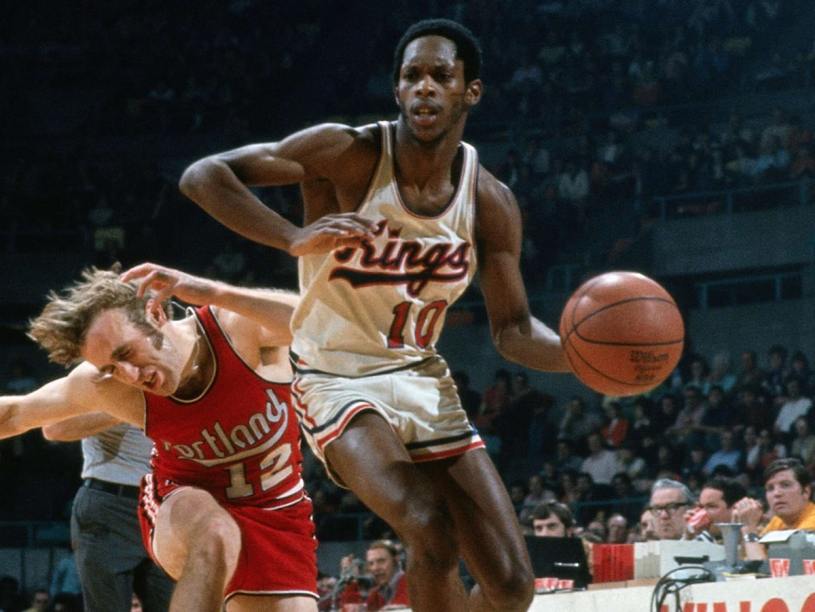
This final NBA Tuesday miniseries of the listicle nature has just 5 entries left in it, including today’s examining of the Sacramento Kings—we simply hopped on US Interstate 5 and cruised south for 8 hours, you know? Simple. It’s been a very long time since this franchise has won an NBA title, but it hasn’t been for a lack of success or trying. Circumstances are rough for some organizations, sacrificed at the money altar.
No. 10: Arnie Risen, C—48.9 WS (1948-1955)
He was our pick for the Finals MVP in 1951 when the Rochester Royals won the NBA championship, and he was a 4-time All Star for the team from 1952-1955. He averaged 13.7 ppg and 11.2 rpg across 7 seasons with the team, and he improved those numbers to 16.6 ppg and 12.4 rpg in 38 playoff contests for the organization as well. All of this and more earned him entry into the Hall of Fame, despite the short career.
No. 9: Bob Davies, PG—49.7 WS (1948-1955)
He was the floor leader of that 1951 championship team, posting 14.3 ppg and 4.9 apg over his 7-year NBA career, all with the Royals. He too was a 4-time All Star (1951-1954) on his way to the Hall of Fame, as well. Across 38 postseason games with the franchise, he put up 13.3 ppg and 4.3 apg. He was already 29 years old when he started playing professionally in 1948 with the organization, as his best shooting year was his last.
No. 8: Sam Lacey, C—50.4 WS (1970-1981)
He started his career in Cincinnati and then moved with the organization to Kansas City, making him both a Royal and a King. His sole All-Star season came in 1975 when he finished 10th in the MVP voting. Overall, he contributed 11.1 ppg, 10.5 rpg, 4.0 apg, 1.7 bpg, and 1.5 spg for the franchise in 11-plus seasons. He was a diverse playoff producer, too, in 29 contests over the years: 9.4 ppg, 9.9 rpg, 5.0 apg, 1.9 spg, and 1.5 bpg.
No. 7: Mitch Richmond, SG—50.4 WS (1991-1998)
After 3 years lighting it up with Golden State to start his career, he was acquired via trade and spent several productive years in Sacramento: 23.3 ppg, 4.1 apg, 3.7 rpg, and 1.3 apg in 517 regular-season games. He also made 6 straight All-Star teams (1993-1998) while with the Kings, but this was a rough time for the franchise, and he only played in one postseason for the organization (1996). Still, he made the Hall of Fame in the end.
No. 6: Nate Archibald, PG—53.7 WS (1970-1976)
The No. 19 overall pick, he wasn’t really “tiny” at 6-foot-1, but the nickname stuck. He was a 3-time All Star (1973, 1975, 1976) in his 6 seasons with the team, and he also topped the NBA in assists and scoring during the same season (1973). Overall, during his Kings tenure, he posted 25.2 ppg, 8.1 apg, and 1.5 spg in 433 games, but again, this was not high time for the franchise, and he made just 1 playoff appearance. Shame.
No. 5: Jerry Lucas, PF—57.8 WS (1963-1969)
He was the No. 6 pick in the 1962 Draft, but due to contract issues, he did not debut until the start of the 1963-1964 season when he was voted ROTY. He led the NBA in field-goal percentage as a rookie, too, while making the All-Star team all 6 years he played for the franchise. His numbers got him into the Hall, too: 19.6 ppg, 19.1 rpg, and 3.0 apg in the regular season with 16.2 ppg and 16.8 rpg added in the postseason. Amazing.
No. 4: Peja Stojaković, SF—59.8 WS (1998-2006)
Despite being the No. 14 pick overall in the 1996 Draft, he opted to play in Spain for 2 years before coming to the NBA. But when he did, he was pretty good: 3-time All Star (2002-2004), free-throw champ (2004), and all-around spark plug for a playoff team. In 8 seasons with the team, he averaged 18.3 ppg, 5.0 rpg, and 1.0 spg. In 57 playoff contests, he added 17.3 ppg and 6.0 rpg as the team had its best Sactown years with him.
No. 3: Bobby Wanzer, SG/PG—63.9 WS (1948-1957)
He was on 5 consecutive All-Star teams from 1952-1956, after entering the league at age 27. He topped the NBA in free-throw percentage once (1952) and was a member of the 1951 title team, too. Overall, he contributed 12.2 ppg, 4.5 rpg, and 3.2 apg to the cause in the regular season, and then he added 14.6 ppg, 5.8 rpg, and 3.5 apg in 38 playoff games. He’s in the Hall of Fame for being part of the league’s early foundation.
No. 2: Jack Twyman, SF/SG—75.0 WS (1955-1966)
Somewhat an ironman for his day, he topped the league in games played 7 times in his career, while also making 6 All-Star teams in the process. He put up 19.2 ppg and 6.6 rpg in 823 regular-season games in Rochester and Cincinnati, as he migrated with the franchise. In 34 playoff games, he tossed in 18.3 ppg and 7.5 rpg. He had been the No. 10 overall pick in the draft, so he did pretty well in a Hall of Fame career. Yes.
No. 1: Oscar Robertson, PG—154.2 WS (1960-1970)
The WS mark is no joke; he’s one of the best all time, of course. The voted NBA MVP in 1964 and our pick for the award in 1965, he made the All-Star team in every season he was with the Royals. He also topped the league in assists 7 times while with the team and led the NBA in scoring once, too. He averaged a triple double in his second NBA season; the stats are too numerous to list here. He’s in the Hall, obviously. STAR.
 Daily McPlay: (mostly) Historical Sports Analysis with TENACITY & VERVE