
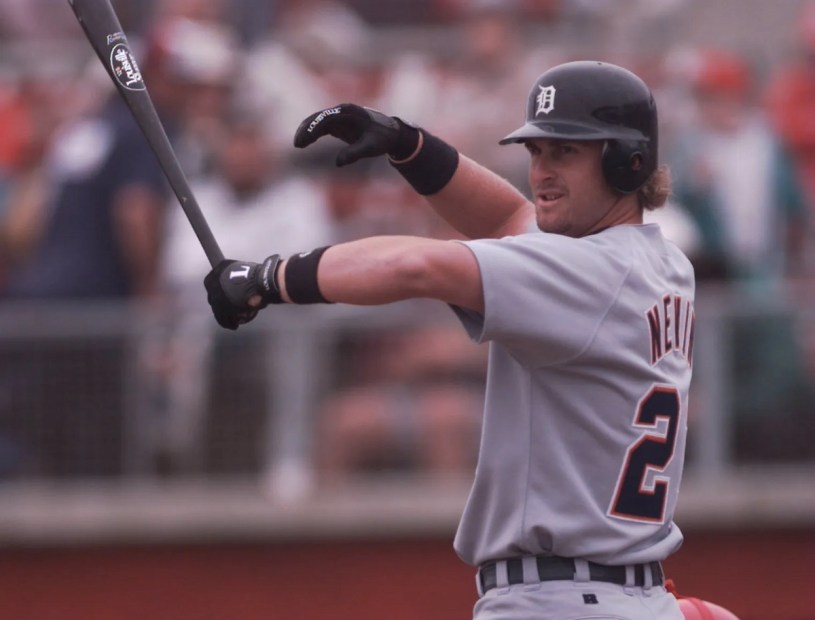
We are going to start randomly examining the careers of MLB players when we feel like it, usually on Mondays when we need a break from other things in life that we do. Today, our first “edition” of this sequence, focuses on former Los Angeles Angels Manager Phil Nevin and his playing career as the No. 1 overall pick in the 1992 MLB Draft. We remember watching Nevin on television when we were in college.
His 12-year career spanned from 1995 to 2006 with 7 different major-league teams, and it didn’t amount to a lot, in truth: he made a single All-Star team in 2001 while playing with the San Diego Padres and finished with just 15.9 WAR for his career. That’s relatively disappointing for the No. 1 overall pick in any draft, obviously. Nevin’s career .814 OPS was solid, for sure, but his defensive shortcomings (-5.5 dWAR) hurt him.
Drafted by the Houston Astros, he was traded to the Detroit Tigers in his first MLB season—combining for a .537 OPS across 47 games for the 2 teams together at age 24. Retrospectively, that’s not the debut you want from a top prospect, and obviously the Astros valued Detroit closer Mike Henneman in the moment more than they expected to get from 6 seasons of Nevin. That’s a damning assessment right there, in matter of fact.
Houston got 8 saves out of Henneman but missed the 1995 postseason by 1 game, trailing the Colorado Rockies for the first-ever, wild-card spot in the National League postseason. This was a potential steal for the Tigers, to unload a veteran reliever and secure the next 5-plus seasons of control for a former No. 1 overall pick. Overall, Nevin ended up playing 160 games for Detroit during the 1995, 1996, and 1997 seasons.
That’s about a full season of ABs, for sure, and Nevin was 26 years old by the end of 1997. The statistical output for those 160 games and 518 plate appearances? A .246 batting average, a .745 OPS, 18 home runs, 66 RBI, and 44 walks—along with 134 strikeouts and minus-1.4 dWAR while playing 4 different positions, although mostly at third base and left field. Generally, he was of negative value for the Tigers (-0.4 WAR).
Even though they would have had him under control for 3 more seasons, the Detroit front office flipped him for basically nothing (seriously) to the Anaheim Angels, where Nevin would spend the 1998 season. At this point, he was a worthless commodity, and the Angels organization had nothing to lose by taking a chance, with his low salary ($210k for 1998) under club control. Why not? Maybe it all could click in Anaheim.
Nope. In just 75 games with the Angels, Nevin hit .228 and posted a .662 OPS, while bringing even-zero value to the club. So, Anaheim moved him after 1 season to the Padres, a team coming off the surprise 1998 NL pennant. This was an interesting move for San Diego: clearly, the Padres front office understood that Nevin was a bust at this point, and if they wanted to get back to the Series, why were they acquiring him?
Low risk, high reward, perhaps. Sound familiar? This is where the narrative changes for Nevin, during his age-28 season, with his fourth organization in 5 years. Everything suddenly clicks for the draft bust, as he played in 128 games, hit .269 with an .880 OPS. He hit 24 HRs, posts 85 RBI, and got walked a career-best 51 times. He posted a positive dWAR mark (0.8) for the first time ever, too. San Diego’s gamble paid off nicely.
So what happened with the Padres in 1999 at age 28 that suddenly made the lights go on in Nevin’s game? We spent a lot of time analyzing situations like these in Boston and San Francisco, and when you remember who the Padres manager was at this time—one Bruce Bochy—then it all makes sense, doesn’t it? We hate to say it, but it’s easy to connect the dots and assume Nevin started using PEDs with the Padres in 1999.
The timing of it is right, both individually for Nevin and in an MLB-wide sense after the 1998 regular season. Hitherto, Nevin had played in 253 MLB games and shown no ability to be more than a replacement-level player. He was desperate and psychologically beaten by the sport that used to come so easy to him. His club-control days were almost over, and if he wanted to stay in the majors, he had to make a change. Voila!
Sadly, it checks all the circumstantial boxes, and the Padres were a PED-friendly team as we know from Ken Caminiti and his meteoric rise in San Diego. Over 806 games across parts of 7 seasons with the Padres (1999-2005), Nevin managed a .288 batting average and an .862 OPS, easily the best numbers of his career at any single stop along the way. Oh, did we mention he got $28.2M from San Diego in the process? Checkmate.
This is a failed No. 1 overall draft pick who made just $882k over his first 5 years in MLB, knowing his time was up. He joins a team that has a reputation for PED enablement, with a manager who is clearly looking the other way in the attempt to win at all costs. We can confidently assess all these factors and conclude that Nevin used PEDs while in San Diego; nothing else makes sense given the statistical pattern hitherto. Nope.
There might be an argument that maybe he was a late bloomer to come into his prime at age 28, but considering his pedigree as the No. 1 overall draft pick, that’s not likely in this scenario, especially with so many teams just tossing him on the scrap heap before San Diego decides to “take a chance” on his hibernating talents. The Padres had to ensure a return on their financial investment, as well, so … yeah.
By 2005, however, at age 34, Nevin started to lose his effectiveness for whatever reason. After 73 games, the San Diego front office dumped him and his $9.6M salary for that season on the Texas Rangers for Chan Ho Park. Through the first 4 months of the season, Nevin had just 9 HRs and a .699 OPS. The Rangers were 53-50 on July 30 and in contention for a postseason spot they didn’t end up getting, no thanks to this trade.
Nevin played in just 29 games for Texas, hitting a mere .182 with 8 RBI. And they’re stuck with him for one more season of his fat contract, too, at almost $10.5M for the 2006 season. But he hit just .216 through 46 games with the Rangers, and they traded him to the Chicago Cubs for nothing (salary dump). In friendly Wrigley Field, Nevin had a huge rebound: in 67 games with the Cubbies, he posted an .832 OPS. Is he back?!
[Guess who the Cubs manager was in 2006? Dusty Baker. We don’t find this to be a coincidence.]
Chicago finishes 30 games under .500 on the year, so by the trade deadline, the Cubs flipped Nevin to the Minnesota Twins, who would win the AL Central and reach the postseason. In just 16 appearances with the Twins, the final 16 games of his career, Nevin hit just .190 with a .625 OPS, disappearing forever into the dustbin of baseball’s encyclopedic history. So much for the late-bloomer theory at this point, right? Right.
Is it curious how Nevin’s best 2 stops in his MLB career came under PED enabling managers? In no other locale did his OPS rise over .745, but he managed an .862 OPS in San Diego under Bochy and an .832 OPS in Chicago under Baker. His other managers? Terry Collins in Houston, Sparky Anderson and Buddy Bell in Detroit, Collins again in Anaheim, Buck Showalter in Texas, and Ron Gardenhire in Minnesota.
Let’s look at those managers:
- Collins had a .532 winning percentage in 3 seasons with the Astros, and he later led the 2015 New York Mets to the NL pennant;
- Anderson needs no commentary here, as he won World Series with 2 different organizations (Cincinnati, Detroit). We awarded him 5 MOTY nods in our ongoing analyses;
- Bell was a mediocre manager in his three MLB stops (Detroit, Colorado, Kansas City);
- Showalter had a lot of success over 22 years as a manager, posting a .509 winning percentage and being known for taking teams to the brink of postseason success (New York Yankees in 1995, Arizona Diamondbacks in 2000, etc.);
- Gardenhire took the Twins to the postseason 6 times in 9 seasons from 2002-2010.
With the Bell exception, it’s clear Nevin benefitted from some good managerial tutelage in his stops where he couldn’t hit for shit. So, this isn’t a case of Bochy or Baker giving Nevin unique wisdom or any myth-making shit like that. The only thing those 2 managers gave him was perhaps the green light to use PEDs. Nevin had some good managers during his entire career but only thrived under known dugout cheaters.
Since Nevin was the manager of the Angels for almost 2 seasons, it begs the question: did he pass on his experiences to his players? We’re guessing no, since his teams didn’t reach the postseason despite having Mike Trout and Shohei Ohtani on them. He was just 119-149 as a manager, so it’s safe to say with all the injuries on those teams as well, he was not pushing immorality on his players at any cost to win as manager.
[We respect that; he did what he did, perhaps, in his own career for his own reasons, but he leaves the choice to players to do what they need to do for them.]
In the end, we never would have looked at Nevin’s career so closely if not for Collins being a candidate in our 1996 NL MOTY analysis early today. It’s fun to analyze a career without any expectation only to discover some very odd anomalies and coincidences that fit a previously explored pattern of behavior. We don’t do this in any regard to Nevin, personally; we don’t know the guy at all. But stats are facts that shout to us, loudly.
 Daily McPlay: (mostly) Historical Sports Analysis with TENACITY & VERVE