
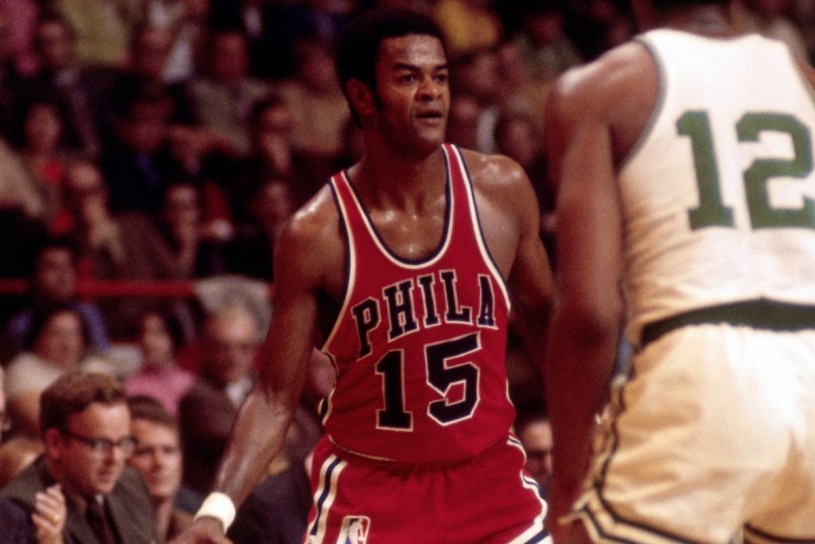
NBA Tuesday departs the Deep South today and heads to the center of independence: Philadelphia. The 76ers franchise was born in Syracuse as the Nationals at the dawn of the NBA, and the organization did just fine for a long time, whether in upstate New York or in Pennsylvania. With 5 trips to the Eastern Conference semifinals in the last 6 seasons, too, the 76ers always have had great players to dominate—and fill this list.
No. 10: Andre Iguodala, SG/SF—61.2 WS (2004-2012)
The ninth overall pick, he made just 1 All-Star team while with the 76ers—and then left town for greater glories elsewhere. In 615 regular-season games with Philly (all starts), he averaged 15.3 ppg, 5.8 rpg, 4.9 apg, and 1.7 spg. Unfortunately, in 8 seasons, he only played in 35 postseason games for the franchise (13.8 ppg, 5.7 rpg, 4.8 apg, and 1.8 spg). Only once did the team get out of the first round (2012) with him on the roster.
No. 9: Billy Cunningham, SF/PF—63.2 WS (1965-1972, 1974-1976)
Picked at No. 7 overall, he had 2 stints in Philly while making 4 consecutive All-Star squads (1969-1972) during the first stint. He also helped the 76ers win the NBA title in 1967, before jumping to the ABA in 1972. In 654 regular-season games across 9 seasons with the organization, he put up 20.8 ppg, 10.1 rpg, 4.0 apg, and 1.2 spg. In 39 playoff games with the franchise, he added 19.4 ppg, 9.1 rpg, and 3.2 apg. Investment good.
No. 8: Joel Embiid, C—63.5 WS (2016-present)
If this guy could stay healthy, he’d be much higher on this list: he was the No. 3 pick overall in the 2014 Draft, but he missed 2 seasons out of the gate with foot injuries—and he’s never played in more than 68 games in a single season. But he’s been a 7-time All Star and the voted 2023 NBA MVP. Twice, he’s topped the league in scoring, too (2022, 2023). His 76ers haven’t been able to get deep in the postseason, though.
No. 7: Wilt Chamberlain, C—71.2 WS (1965-1968)
In just 3.5 seasons with the franchise, he certainly had an impact—winning the MVP Award in all 3 full seasons (1966, 1967, 1968) and winning the NBA Finals MVP in 1967, too. He led the league in rebounding in those 3 MVP seasons and topped the NBA in scoring once (1966). Of course, he was an All Star in all 4 seasons with the team as well. The superlatives are pointless here: he cleared 20+ WS in every full season.
No. 6: Allen Iverson, PG/SG—79.7 WS (1996-2006, 2010)
The No. 1 overall pick didn’t disappoint: 7 straight All-Star nods (8 overall), 4 scoring titles (1999, 2001, 2002, 2005), and 3 times an NBA steals champ (2001-2003). He also was voted the NBA MVP in 2001, while leading the team to the NBA Finals that same year. He’s both famous and infamous for other things, of course, but the numbers and statistics speak for themselves in the best ways. The dude was full-on awesome.
No. 5: Maurice Cheeks, PG—87.7 WS (1978-1989)
This second-round pick paid huge dividends for the 76ers: 4 All-Star selections (1983, 1986-1988) and an NBA title in 1983 (although he did have some help). His 11 seasons with the franchise included 853 regular-season games (852 starts, 12.2 ppg, 7.3 apg, 3.0 rpg, 2.3 spg) and a whopping 115 playoff contests (15.0 ppg, 7.0 apg, 3.5 rpg, 2.3 spg). All of this added up to the Hall of Fame, as well, so the second-round risk paid off.
No. 4: Hal Greer, SG/PG—102.7 WS (1958-1973)
The 14th overall pick, he made 10 consecutive All-Star games with both the Syracuse (1961-1963) and Philadelphia (1964-1970) teams. He was a member of the 1967 champions, and in 1,122 regular-season games with the organization, he posted 19.2 ppg, 5.0 rpg, and 4.0 apg in a Hall of Fame career. In the playoffs, he contributed 20.4 ppg, 5.5 rpg, and 4.3 apg across 92 more contests. Not much more to be done.
No. 3: Charles Barkley, PF/SF—106.1 WS (1984-1992)
In just 8 seasons with the 76ers, he reached tremendous heights despite never reaching the NBA Finals with the team. As the No. 5 overall pick, he delivered 6 straight All-Star nods (1987-1992) before being traded away. He topped the NBA in 2-point percentage for 5 straight years (1987-1991) and in eFG twice as well (1987-1988). In 1987, he also led the league in rebounding (14.6 rpg). Definitely an all-time great player, yes.
No. 2: Julius Erving, SF/SG—106.2 WS (1976-1987)
Legendary as he was, he didn’t join the team until the ABA collapsed. He was voted the 1981 NBA MVP, and overall, he was an All Star in every one of his 11 seasons in the NBA—all with Philadelphia. He obviously was a key member of the 1983 champs, as he averaged 22.0 ppg, 6.7 rpg, 3.9 apg, 1.8 spg, and 1.5 bpg over 836 regular-season games and 21.9 ppg, 7.0 rpg, 4.2 apg, 1.7 spg, and 1.7 bpg across 141 playoff games, too. Damn.
No. 1: Dolph Schayes, PF/C—142.4 WS (1949-1964)
This could be a surprise to younger fans without historical perspective, but Schayes spent his whole career with the franchise—playing his final season during the team’s first year in Philadelphia. He was our pick for the 1955 NBA Finals MVP and DPOY, while we also chose him as our 1954 and 1958 league MVP. He made 12 All-Star teams in a row (1951-1962) and is in the Hall of Fame. Oh, and he was the 1951 rebounding champ.
 Daily McPlay: (mostly) Historical Sports Analysis with TENACITY & VERVE