
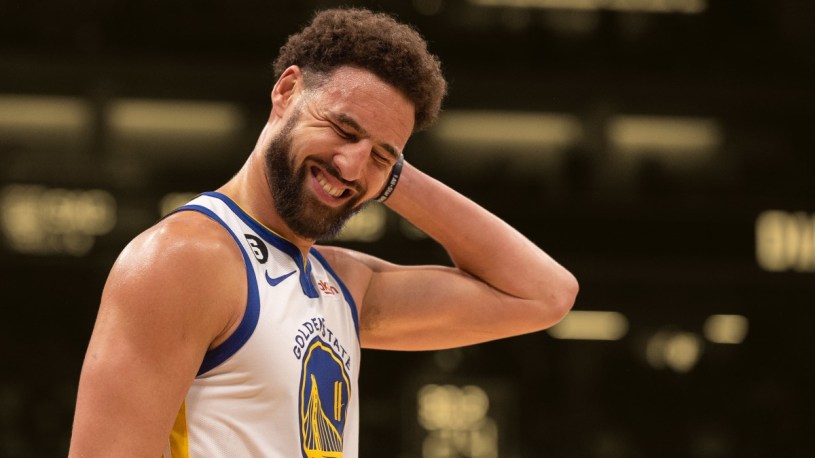
A long time ago, we gave some advice to Golden State Warriors Head Coach Steve Kerr—a man we truly respect—on how to manage his roster this year. Now that the regular season is over, it’s time to check in and see how the Warriors did … and it’s a mixed bag. The team finished with a 46-36 record, but that only earned it the No. 10 seed in the Western Conference playoffs (which used to be just for 8 teams, pre-Covid).
First, only 1 player overaged over 30 minutes per game: Stephen Curry. He played 32.7 mpg, which is his lowest career mark for a full season. He also played 74 games, which is his highest number since the 2018-2019 season when he played in 69 games. With just 7.2 Win Shares, Curry posted the lowest mark there since his 2010-2011 season (6.6 WS), when he was just in his age-22 year. We’re not sure how to feel here.
Basically, he played in too many games and didn’t yield anything close to “normalcy” while he was on the floor. With just .142 WS/48 this year, it was the worst season os his amazing career since that same age-22 year. He is coming back down to Earth now that he has turned 36 last month, and yet he was asked to do more this year than perhaps any other season in a long time, due to the decline in supporting-cast value.
We can’t blame Kerr for this, although the backups at Curry’s “point guard” position were plentiful (see below). But Curry is a transcendent player, and when the team had to have him on the court, it put him on the court. The Warriors did have a nice 5-game cushion on the 11-seed team, but no one knew that’s what it would be. We did see the team sit Curry for Game 82 knowing it didn’t matter for seeding purposes, so …
Maybe Kerr did his best there.
Second, there were 6 other players who averaged between 26.3 and 29.7 ppg. Throw in Curry, and that’s just a 7-man rotation, really, which doesn’t help a team with 4 core players in aging twilights of their careers. This regular roster dynamic reflects some balance, too, with 2 young players, 1 player in his alleged “prime”, and the aforementioned 4 old guys. That’s a good blend, considering the GSW roster and talent level this year.
Yet Kerr didn’t give enough minutes to a few other players, for whatever reason. When we look at WS/48 for this organization, rookie Trayce Jackson-Davis (.205) was the best player on the team this season, all told, sabermetrically. Yet Kerr didn’t know that from the start of the season, of course, and TJD only ended up playing 16.6 mpg—while starting just 16 times. But if he’d gotten more minutes, it would have helped a lot.
Also, at .162 WS/48, age-27 Kevin Looney needed to get more playing time, too. He did start 36 times, but at just 16.1 mpg, clearly Kerr needed to give him more floor time. With more trust in Jackson-Davis and Looney alone, Kerr could have lowered the mpg marks for several players in his Top 7 rotation. Yes, it’s easy to say this in retrospect, for sure, and like we said, we respect Kerr a lot for many reasons. But it’s still a problem.
So, again, Kerr maybe did his best here, despite leaving a lot of additional wins on the table, perhaps.
Third (and finally), some players just got too much floor time, which could have been distributed in the direct of better WS/48 options in this Top 9 on the GSW roster for maximization. Who knows? Maybe the Warriors could have won 5 extra games as a result of these minutes-played adjustments. But players like veterans Klay Thompson (.075) and Andrew Wiggins (.070) should never have played so much. Never.
They were 13th and 14th, respectively, on the team this year for value per minute played. Yet Thompson played the second-most minutes on the team (29.7 mpg) and Wiggins got the fourth-most time (27.0). Benchwarmers like Dario Šarić (.123 WS/48, 17.2 mpg) and Moses Moody (.101, 17.5) definitely should have played more as well. So, adding these 2 guys to the rotation would have only helped the Warriors out.
These are season-final numbers, although they didn’t accrue in a vacuum. Kerr has to have had better data access/flow than we have, too, so he must have been aware of these issues by December when Golden State was just 10-14 and struggling. Now to his credit, Kerr righted the ship just fine through all circumstances (injuries, suspensions, etc.) to close on a 36-22 run to clinch the postseason opportunity. However … yeah.
His over-reliance on a washed-up player like Thompson cannot be forgiven or overlooked. The veteran “star” hasn’t posted a .100-plus WS/48 mark since the 2016-2017 season. His .091 WS/48 effort in the 2021-2022 season that resulted in another title for the team looks stellar in comparison to the painful marks of the last two seasons (.066 in 2022-2023). Thompson’s career best for comparison? A .172 mark in 2014-2015.
This is all on Kerr. Last year, he chose to play Thompson and Jordan Poole too much when they were absolutely garbage in terms of value, and this year he did the same with Thompson again—with Wiggins’ decline replacing Poole’s embarrassingly bad play. These decisions have left the team with low-level seeding situations in the postseason, when perhaps better roster management would have achieved a lot more.
Our postscript to all this is the performance of Chris Paul, an NBA legend who joined the team this year—and should have played a lot more instead of Thompson, specifically. Even in his age-38 season, CP3 managed to finish with .136 WS/48, which was fifth best on the roster. He did miss 24 games due to injury and maintenance, but Paul was only sixth on the team with 26.4 mpg: Thompson’s ego mandated more mpg.
Kerr fell for that idea of “loyalty” with Thompson, when CP3 should have gotten more minutes. We do realize Paul’s injury history, so maybe Kerr was trying to limit his exposure there. So be it, but giving Thompson so many more minutes over other options at shooting guard—even rookie Brandin Podziemski (.100) carried more value per minute than Thompson— was a huge mistake for Kerr to make.
We will see what happens this week in the play-in games: as it stands now, the Warriors will have to win 2 road games, in Sacramento and then either Los Angeles or New Orleans, respectively, to even get the mere 8 seed in the postseason—and a 7-game series matchup with the Oklahoma City Thunder in the opening round of the formal/official playoffs. Good luck, Golden State: the Thunder went 3-1 against GSW this year.
Because it’s the NBA, we can see the league making sure the Warriors advance 1 game in the play-in round, and it might depend which team loses the 7/8 play-in matchup in terms of whether Golden State advances. If New Orleans loses, then we can see the Warriors beating them to get that 8 seed; if the Los Angeles Lakers lose, then we don’t see GSW moving past the Lake Show for obvious reasons: just like last year’s semifinal.
Only time well, and as always, we don’t recommend you use our ideas as betting advice: we’re often wrong … yet never in doubt!
 Daily McPlay: (mostly) Historical Sports Analysis with TENACITY & VERVE
Golden State falling quick
LikeLike