
We “finished” our first NFL Thursday miniseries a long time ago, and now that the 2023 season has ended, we can do our NFL MVP assessment of that 2023 season. Hopefully, you know the drill at this point: we take on the NFL MVP winner, and then in a separate column later, we take on both the Super Bowl MVP winner and the Rookie of the Year winners. It’s fun; it’s scientific; it’s uniquely objective; and it’s always debatable!
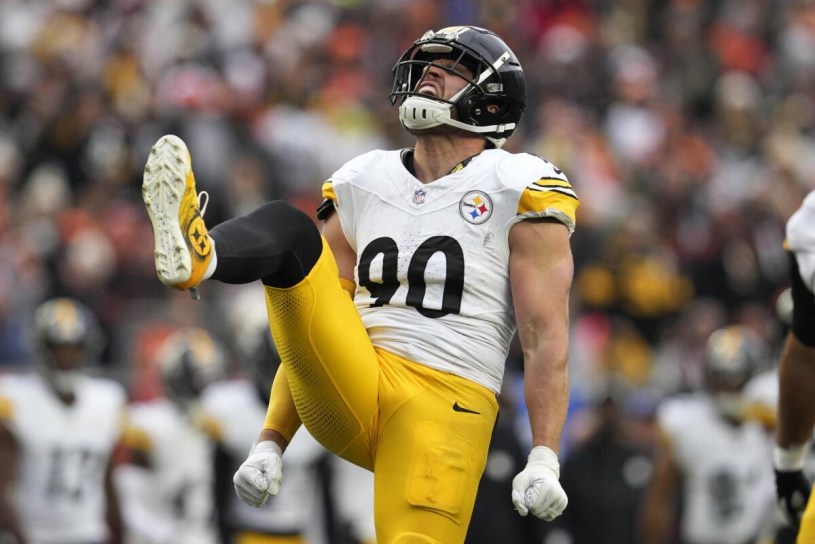
2023 MVP: Lamar Jackson, QB, Baltimore (original); T.J. Watt, LB, Pittsburgh (revised)
It was a strange season for the NFL, and in the end, Baltimore Ravens quarterback Lamar Jackson won his second MVP vote; his first vote win came in 2019, and we objectively gave it to someone else. Maybe Jackson will have better fortune this time around with us; maybe not. We shall see. Let’s come up with a short list of candidates, starting with the QBs, as usual. Six of them posted 100+ QB ratings, and five of them stand out:
- Brock Purdy, San Francisco: 113.0 QB rating, NFC West Division champs
- Dak Prescott, Dallas: 105.9 QB rating, NFC East Division champs
- Lamar Jackson, Baltimore: 102.7 QB rating, AFC North Division champs
- Tua Tagovailoa, Miami: 101.1 QB rating, AFC East Division co-champs
- C.J. Stroud, Houston: 100.8 QB rating, AFC South Division champs, rookie
Only Purdy’s QB rating really jumps off the page here, although we do have to consider the rushing yardage accrued by these guys as well: Jackson added 821 yards on the ground, which is significant. None of the others surpassed 250 yards rushing, so we’re only going to advance Purdy and Jackson here to our final round of candidates. Now, what about the running backs and wide receivers? Here’s a short list:
- Christian McCaffrey, RB, S.F.: 2,023 scrimmage yards, 21 scrimmage touchdowns, 3 fumbles
- CeeDee Lamb, WR, Dallas: 1,862 scrimmage yards, 14 scrimmage TDs, 3 fumbles
- Tyreke Hill, WR, Miami: 1,814 scrimmage yards, 13 scrimmage TDs, 1 fumble
Obviously, each of these guys played with a top QB, too, so that will hurt them in a final-round comparison. Thus, we should generally just not advance any of them, including Purdy, as the “teammates” rule is going to apply here, as we have been pretty consistent with that pattern and structure throughout our evaluation process in this miniseries. That leaves just Jackson so far as we know look to defensive players on this list:
- DaRon Bland, CB, Dallas: 9 interceptions, 5 return TDs, 69 tackles, 15 passes defensed
- T.J. Watt, LB, Pittsburgh: 19 sacks, 68 tackles, 4 forced fumbles, 1 IN, 8 PDs
- Bobby Wagner, LB, Seattle: 183 tackles, 3.5 sacks, 3 PDs
Bland had an incredible year, but he’s the third Cowboys player to come up in discussion, so he’s out. We will advance Watt and Wagner, as the Steelers made the postseason and the Seahawks just missed out on the postseason due to a tiebreaker. That leaves us with 3 unique finalists here, to be sure, and we have to see what each player was working with in terms of support from other players on their respective rosters:
- Baltimore: No skill players over 1,000 scrimmage yards, top AFC scoring defense
- Pittsburgh: no QB over 81.5 QB rating, but 3 position players over 1,150 scrimmage yards
- Seattle: QB with 92.1 QB rating, and 2 position players over 1,110 scrimmage yards
Jackson was somewhat of a one-man offense for his team, totaling almost 4,500 yards alone. But he did have that defense behind him. Watt had no QB help, even though there were some skill-position guys stepping up regardless. Wagner had good QB support and some skill-position guys to boot. For the record both Pittsburgh and Seattle were outscored on the year despite the presence of their defensive studs. Wow.
We’d have to give the edge to Watt over Wagner, for two reasons: actual playoff qualification and significantly weaker QB performances. Yes, both the Steelers and the Seahawks needed to use multiple starters to get through the season, but clearly Seattle got better overall QB play which meant better offensive support, generally, than Watt was getting in Pittsburgh. It’s splitting hairs, but we have to do it.
So, it’s Watt versus Jackson, really, and we have to go with Watt—for clearly, the Steelers would not have been in the postseason without him, and the Ravens defense might have been enough on its own to carry a Baltimore offense to the postseason if the QB was someone else other than Jackson. We don’t know this for sure, as the Ravens offense is also devoid of talent beyond Jackson. But there’s these things to consider:
- Two Ravens did post over 900 yards from scrimmage, and they might have had a third do it if not for injuries and/or Jackson taking 148 carries for himself. Running back Gus Edwards got 198 carries, but if he had gotten 100 more with Jackson still at QB, the offense would have been just as effective, probably;
- Baltimore’s mighty defense only coughed up 44 points fewer than the Steelers defense—thanks to Watt. The Ravens defense had the luxury of knowing its offense could grind out a drive and rest the unit; the Pittsburgh defense was on the field a lot more than the Baltimore defense, but all that resulted in was a mere 44 extra points. Because Watt had a lot more value, as we see it, than Jackson.
We like Jackson a lot; we really do. But he’s never had to carry the offense out of necessity; he does it as a luxury, really. There is a different there in value, between what Watt does and what Jackson does, therefore. The Steelers were a lot less of a team than the Ravens—by 183 points in scoring differential. Yet somehow, Pittsburgh only posted 3 fewer victories than Baltimore, and we’re giving that value credit to Watt.
We didn’t even realize it until now (our memories aren’t as sharp as they used to be), but this is the second time in 3 seasons we’ve given this award to Watt. That puts him in elite NFL company, historically speaking. Impressive, considering his older brother never earned this award from us … sorry, J.J.!
 Daily McPlay: (mostly) Historical Sports Analysis with TENACITY & VERVE