
As NBA Tuesday marches on, it still strikes us as amusing that there is a team called the Pelicans in the league. Born and raised in the 1970s, it just seems so silly, like a cartoon character or something. Alas, we leave the upper North of the nation and float down the Mississippi River all the way to New Orleans, where the original Hornets franchise now resides. What a long, strange trip it’s been, right? That never gets old …
No. 10: Ryan Anderson, PF—16.2 WS (2012-2016)
The organizational “reset” after the second Hornets franchise was birthed accounts for the very low WS marks on this list, starting with this guy … someone that no one is going to mistake for a “great” player. However, he was at his best with this team: 16.1 ppg, 5.9 rpg, and 1.1 apg over 230 regular-season games but just 10.8 ppg, 4.3 rpg, and 2.3 apg in 4 playoff games. His best year was 2012-2013 with 6.5 WS for 1 season.
No. 9: Jonas Valančiūnas, C—19.5 WS (2021-present)
Despite being the No. 5 overall pick once, he’s never made an All-Star team. The Pelicans are his third team in a long NBA career dating back to 2012, and in 220 regular-season games with the organization so far, he’s posted 14.9 ppg, 10.3 rpg, and 2.2 apg. Not bad numbers, which explains the relatively high(er) WS mark in only so many seasons. In 6 playoff games in New Orleans, he’s put up 14.5 ppg, 14.3 rpg, and 3.0 apg. Nice!
No. 8: Zion Williamson, PF—20.6 WS (2019-2021, 2022-present)
As the No. 1 overall pick in the 2019 Draft, he’s been a mild disappointment, missing an entire season due to injury (2021-2022). However, he was an All Star in the year prior to the injury and in the season afterward, too. His stats: 24.7 ppg, 6.6 rpg, and 4.1 apg in 170 regular-season games with no playoff action whatsoever. So, he looks good on paper, but he’s missed so many games already in his career, it just doesn’t seem good.
No. 7: Tyson Chandler, C—21.3 WS (2006-2009)
In only 3 seasons down on the Bayou, he did the dirty work for the early days of the organization after its relocation. Playing in 197 regular-season games, he averaged 10.2 ppg, 11.3 rpg, and 1.4 bpg. But he disappeared in the playoffs over 16 games with just 5.9 ppg, 9.0 rpg, and 1.3 bpg. He was not an All Star while in town, although we picked him for our DPOY in 2005—the year before he arrived in New Orleans.
No. 6: Brandon Ingram, PF—22.9 WS (2019-present)
He was the No. 2 overall pick in the 2016 Draft and played for 3 seasons with the Los Angeles Lakers before being traded to the Pels and blossoming into an All Star in 2020. With averages of 23.2 ppg, 5.5 rpg, and 5.2 apg across 284 regular-season games (all starts) in New Orleans, he’s been a foundational piece for the franchise recently. His playoff numbers—27.0 ppg, 6.2 rpg, and 6.2 apg in only 6 games—reveal this, too.
No. 5: Jrue Holiday, PG/SG—28.5 WS (2013-2020)
He’s been an All Star before and after his time in the French Quarter—but not while he was there, strangely enough. In his 415 regular-season games with the organization, he registered 17.6 ppg, 6.8 apg, 4.2 rpg, and 1.5 spg. He only played in 12 playoff contests, though, despite his 19.3-5.8-4.5-1.0 stat line. As the No. 17 overall pick in the draft a long time ago, he’s had a pretty productive career, including his time with the Pels.
No. 4: P.J. Brown, PF—29.6 WS (2002-2006)
Here’s a surprise name on the list considering he only played 4 seasons with the franchise. But he did have his best season ever (2002-2003, 10.2 WS) with the club. Overall, the second rounder from the 1992 Draft—that was a long time ago!)—managed 10.3 ppg, 8.5 rpg, and 1.8 apg over 315 regular-season contests with the team, but in the postseason (13 games), the numbers dropped to 9.5 ppg, 8.8 rpg, and 1.6 apg … with 1.1 bpg.
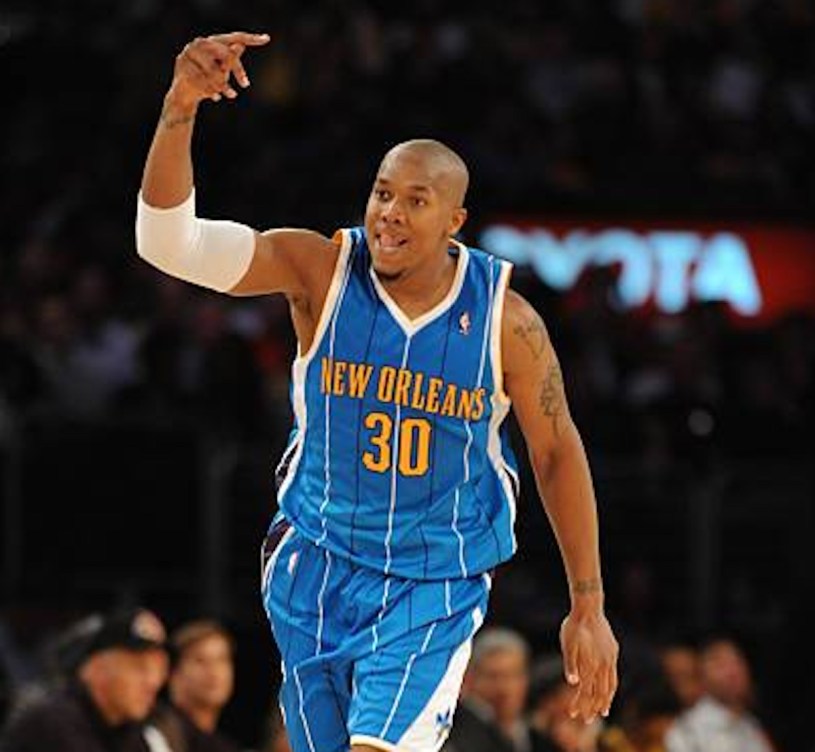
No. 3: David West, SF/PF—47.0 WS (2003-2011)
The No. 18 overall pick in the draft, he was workhorse for a long time in New Orleans: 16.4 ppg, 7.3 rpg, and 2.0 apg over 530 regular-season games and 16.0 ppg, 7.0 rpg, 2.0 apg, and 1.2 bpg in 24 playoff contests. He was a two-time All Star (2008, 2009) for the franchise, as well. Those were his best seasons, sabermetrically, too, with 8.4 WS and 7.8 WS, respectively. He later won 2 rings with the Golden State Warriors (2017, 2018).
No. 2: Anthony Davis, PF/C—72.0 WS (2012-2019)
The Brow was the face of the organization from the moment he was drafted No. 1 overall in 2012. He made the All-Star team in his final 6 seasons with the team before being traded to the Lakers for Ingram and others. He led the NBA in blocks 3 times while with the Pels, and we gave him our MVP hardware in 2018. The numbers are fat: 23.7 ppg, 10.5 rpg, 2.4 bpg, 2.1 apg, and 1.4 spg in the regular season (466 games). Dang.
No. 1: Chris Paul, PG—76.4 WS (2005-2011)
Not much to say about this guy we haven’t already in naming him our NBA MVP in 2008 and recognizing his overall career brilliance. It all started in the Bayou, where CP3 led the NBA in assists and steals in the same season twice (2008, 2009) and topped the league in steals a third time (2011). His overall stats are shiny: 18.7 ppg, 9.9 apg, 4.6 rpg, and 2.4 spg in 425 regular-season games with the Pels—all starts. Damn.
 Daily McPlay: (mostly) Historical Sports Analysis with TENACITY & VERVE