
The annual NCAA men’s hockey championship tournament has a very transparent process for selecting its small field of 16 teams: the Pairwise Rankings, along with a power index, basically dictate the teams that are chosen, and while the human committee makes some adjustments for conference rivals, regional travel, and potential rematches, the 16 teams are well known to everyone who follows the sport before announced.
These hockey rankings are not “novel” as the mathematical model is well established in many fields. Yet clearly college basketball—and the bad joke known as college football—remains totally averse to removing the human element from the selection process, and we know why: money. There’s a lot more of it up for grabs with basketball and football than there is in hockey, and that means the human committee ruins it.
Take today’s announcement of the 68-team field for the men’s Division I basketball tournament, i.e. March Madness. It’s hardly a transparent process, with some math involved with the decision making—and a lot of flawed human input, too, just like football. We get it: the TV ad revenue for the tourney is huge, and it accounts for a large percentage of the NCAA’s operating budget (or at least it used to; who knows now?).
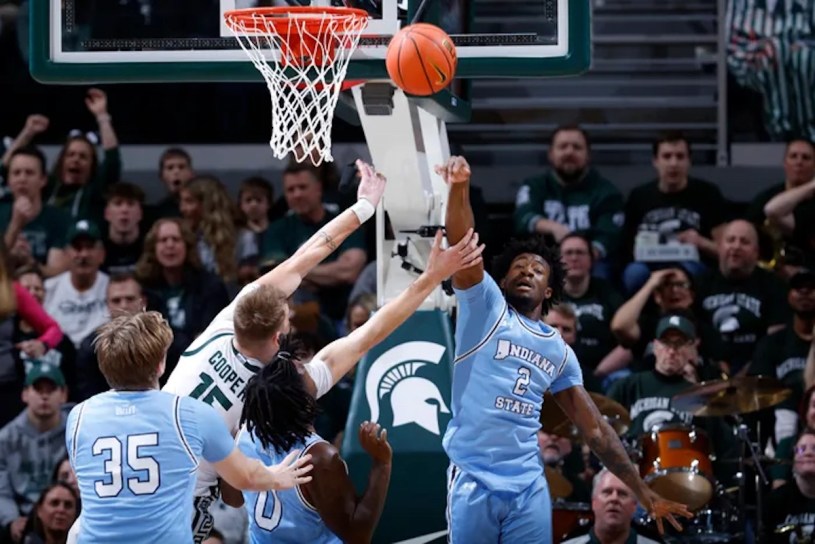
The selection rules claim some reliance on the NET rankings, for example: yet somehow, for the first time ever, a team with a NET ranking in the Top 30 was left out of the tournament (Indiana State). While some “bad” teams in the NET hierarchy must get an invite as automatic qualifiers, there are teams like Virginia (54), South Carolina (51), Northwestern (53), and Texas A&M (45) who got spots before the Sycamores (28).
And we know why, too: money. Those 4 teams are from Power 5 conferences that bring in more TV viewers, even though those respective teams don’t really deserve to be there before Indiana State with its small albeit loyal following in Nowhere, the Middle Of. The Gamecocks are an interesting case study, too, as they have a 26-7 record, bloated by a lot of luck, and they are bound to take a quick fall in this tournament. Watch for it.
We’ve discussed earlier this season how misguided the “bracketology” people are, and look! Gonzaga made it after all as a No. 5 seed. But the committee’s seeming ignorance to the best metrics out there is shocking: Michigan State, for example, is ranked 18th in the KenPom ratings; 18th in ESPN’s BPI rankings; 24th in the NET rankings; and 16th in the SRS rankings. All that should add up to a 5 seed in context of sabermetrics.
Yet, the Spartans suffered 11 losses this season by single digits due to one of the worst “luck” ratings; while South Carolina had the second-best luck in the nation, according to KenPom, Michigan State suffered the eighth-worst luck this season. That’s the difference between the Gamecocks’ 26-7 record and the Spartans’ 19-14 record—even though MSU ranks 31 spots higher in the KenPom overall ratings. Quite the extremes!
Kentucky (23-9) and Michigan State (a 9 seed) have virtually the same KenPom rating, too, yet the Wildcats got a 3 seed. If the Spartans had experienced slightly more luck, maybe they’d have gone 24-9 this season, and they’d have gotten the seed they really deserve. The point is that human error in the evaluation process needs to be removed from the NCAA Tournament selection process—just like it has been in hockey, right?
There is no perfect process for picking teams; we know this. But removing humans from the process is the best for objective transparency for an organization which claims a lot of things in its mission statements—yet clearly does not adhere to those aspirations at all, especially when it has the ability to do so. Instead, the NCAA lets money get in the way of its transparency, and we all suffer as a result. Corruption isn’t pretty, ever.
 Daily McPlay: (mostly) Historical Sports Analysis with TENACITY & VERVE