
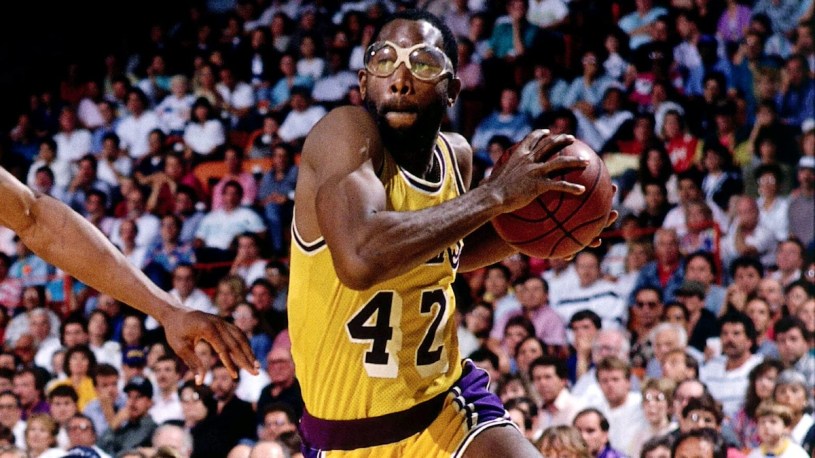
Our NBA Tuesday entry this weekend goes to the front of exhibit line for why “quantity” fools low-IQ thinkers into assuming “quality”: we bring you the Los Angeles Lakers! Normally, we just show collective Win Shares in the rankings, but today, we’re adding WS/48 for major context. That way, you will be able to recognize something we’ve been harping on for the last 4 years here: volume does not mask inefficiency.
No. 10: Byron Scott, SG—65.8 WS, .124 WS/48 (1983-1993, 1996-1997)
It’s surprising to us that Scott never made an All-Star team in his career, but his 11 seasons with the Lakers produced 15.1 ppg, 3.0 rpg, 2.8 apg, and 1.2 spg over 846 regular-season games. Of course, he helped the team win 3 titles (1985, 1987, 1988) as he played in 150 postseason games with L.A., too, putting up 14.8 ppg, 3.2 rpg, 2.4 apg, and 1.4 spg. Not bad numbers considering he was usually playing next to Magic Johnson.
No. 9: James Worthy, SF/PF—81.2 WS, .130 WS/48 (1982-1994)
The No. 1 overall pick in the draft, he made 7 consecutive All-Star teams (1986-1992) and was voted the 1988 Finals MVP. Over 926 regular-season games, Worthy averaged 17.6 ppg, 5.1 rpg, 3.0 apg, and 1.1 spg. In the postseason (143 games), he was even better: 21.1 ppg, 5.2 rpg, 3.2 apg, and 1.2 spg. His best season came in 1989-1990, when he posted a double-digit WS mark (10.6) for the only time in his career, surprisingly.
No. 8: Vern Mikkelsen, PF—83.4 WS, .170 WS/48 (1949-1959)
Probably the most underrated Lakers player ever, he toiled in the Minneapolis years and helped the organization win NBA titles in 1950, 1952, 1953, and 1954. Over 699 regular-season games, Mikkelsen put up 14.4 ppg, 9.4 rpg, and 2.2 apg. He also was a 6-time All Star as well (1951-1953, 1955-1957). In looking at his WS/48 mark, you can see he was equal to the No. 1 player below, in terms of value added per minute played.
No. 7: Shaquille O’Neal, C—97.0 WS, .208 WS/48 (1996-2004)
Seven times during his 8 years with the Lakers, O’Neal was an All Star; we awarded him 3 consecutive league MVPs, too, while he was in Los Angeles (1999–2001). Of course, he was the anchor of 3 straight NBA title teams, as well, winning the Finals MVP nod all 3 times, too (2000–2002). See that WS/48 mark? It dwarfs you-know-who. The stats are nuts, so here are the basics: 27.0 ppg, 11.8 rpg, 3.1 apg, and 2.5 bpg.
No. 6: Elgin Baylor, SF—104.2 WS, .148 WS/48 (1958-1972)
He was a Minneapolis Laker first, although he never won an NBA title—which is a terrible tragedy. Baylor was an 11-time All Star, too (1959-1965, 1967-1970), and we voted him our 1963 NBA MVP. His 846 games with the team produced 27.4 ppg, 13.5 rpg, and 4.3 apg. He was almost as good in the postseason (134 games), too: 27.0 ppg, 12.9 rpg, and 4.0 apg. His teams just could never break through against Boston.
No. 5: George Mikan, C—108.7 WS, .249 WS/48 (1948-1954, 1955-1956)
Technically, his stats include 1 season in the ol’ BAA, but we will keep them here, since they’re considered “official”—and that WS/48 mark is stunning, actually. His stats (23.1 ppg, 13.4 rpg, 2.8 apg) don’t do him justice, but Mikan won our first two league MVP nods (1950–1951), our first 4 DPOY trophies (1950-1953), and a few Finals MVP nods, too (1950, 1952, 1954). Imagine if he had played 20 seasons at that WS/48 level.
No. 4: Magic Johnson, SG/PG/PF—155.8 WS, .225 WS/48 (1979-1991, 1996)
Definitely the most beloved player in organizational history, Magic did it all: led the NBA in steals twice, topped the league in assists 4 times, won 5 titles, topped the MVP vote 3 times, and earned our Finals MVP hardware 5 times, too. He was 31 when he retired early due to health concerns with HIV, even though did have a brief comeback years later. Redux: imagine if he had played 20 seasons at that WS/48 level. Uh huh.
No. 3: Kareem Abdul-Jabbar, C—158.7 WS, .203 WS/48 (1975-1989)
Remember, he played his first 6 seasons in Milwaukee, so by the time he got to Los Angeles, many of his best seasons were already behind him. Imagine if his entire career (.228 WS/48) had been with the Lakers. That being said, we gave him the league MVP nod 5 times in his first 6 seasons out on the Best Coast, so that’s impressive. Like Magic, there are too many awards and honors to list here. His career was amazing.
No. 2: Jerry West, SG/PG—162.6 WS, .213 WS/48 (1960-1974)
He has the distinction of making the All-Star team every year he was in the league, all with the Lakers. Now imagine if he had played 20 seasons at that WS/48 level. Anyway, he won the Finals MVP vote as a member of the losing team in 1969; enough said. We gave him our 1970 MVP nod as well. His stats are impressive, and there’s a reason (several, actually) the league turned his silouette into The Logo. He is a legend, period.
No. 1: Kobe Bryant, SF/SG—172.7 WS, .170 WS/48 (1996-2016)
We will point out that he is not even in the franchise’s Top 10 for WS/48, so the fact he played for 20 years in L.A. is the only explanation for why he’s atop this list. We’ve seen a lot of players on these Top 10 lists that are only there because of longevity, and that basically sums up this guy in a nutshell. He loses almost every comparison, sabermetrically, with most of the guys on this list. He merely wins the “Most Seasons” trophy.
 Daily McPlay: (mostly) Historical Sports Analysis with TENACITY & VERVE