
This entry on our second MLB Monday miniseries is a doozy, for sure, as everyone remembers this postseason as one of the most insane Octobers ever. If you don’t remember why, this week we will walk you down Memory Lane. If you weren’t around for this playoff adventure, well, maybe you’ve read about it before or seen the YouTube videos. Either way, buckle up, as this is as fun a ride as you will get here … truly.
1986 World Series MVP: Ray Knight, 3B, New York (NL) (original); Bruce Hurst, SP, Boston (revised)
Game 6. That’s all we need to say, really. There have been a lot of crazy Game 6s, actually, including 1975 and 1985, for example. But this one stands out for many reasons. In the end, though, it was the New York Mets winning their second World Series in 7 games over the Boston Red Sox, who hadn’t won a Series since 1918 at this point. The Mets won Games 6 and 7 at home to come from behind and claim the MLB championship.
Boston won the first 2 games on the road, before the first N.Y. comeback began, and then the Red Sox won Game 5 at home to take the lead again. Everything seemed set up for the Red Sox, but fate intervened. Mets third baseman Ray Knight (1 HR, 5 RBI, 1.005 OPS) was voted the MVP of the Fall Classic, so we have to decide if that was really the correct choice. He did make a fielding error, which we don’t like in our MVPs.
N.Y. catcher Gary Carter (2 HRs, 9 RBI, .818 OPS) was just as good, if not better, and he played error-free defense. Three different Boston hitters posted OPS marks over 1.000, while on the pitching side, Red Sox starter Bruce Hurst (2-0, 1.96 ERA, 23 IP, 1.043 WHIP) stands out the most. He won Games 1 and 5, before starting Game 7 and getting a no decision as the Boston bullpen lost the matchup and the overall Series.
Knight was the emotional choice, really, and Carter outplayed him for the Mets. But that’s a low OPS mark, despite the high RBI total. And Carter’s game management (3.29 ERA for the N.Y. staff as a whole) wasn’t particularly shocking or surprising. The trio of Red Sox hitters—center fielder Dave Henderson, rightfielder Dwight Evans, and second baseman Marty Barrett—are indistinguishable from each other.
We’re going with Hurst here, even though he didn’t win Game 7, and his team didn’t win the Series. If the Sox had won this in six games, he would have been the choice, and he did fine in Game 7 on the road, even if the bullpen took the loss. It’s unconventional, but it’s more honest than Knight’s relatively underwhelming performance, overall, that’s for sure. Hurst is our first losing MVP pick since the 1947 World Series, as well.
1986 ALCS MVP: Marty Barrett, 2B, Boston (original); Don Baylor, DH, Boston (revised)
The Red Sox came back from a 3-1 deficit in this series to win it in 7 games, thanks in part to this famous home run by Henderson in Game 5 that stoped the California Angels dead in their tracks. In the end, Barrett (5 RBI, .840 OPS) was named the MVP of the matchup. We think designated hitter Don Baylor (6 runs, 1.046 OPS) and catcher Rich Gedman (1 HR, 6 RBI, .879 OPS) are more deserving, however.
And what about the Angels? They almost won the matchup, but honestly, after having their hearts ripped out in Game 5, they played like crap in the final two games back at Fenway Park—losing both by a combined 18-5 score. So, we’re going with Baylor here for the superior OPS, even though he had just 2 RBI in the series. He was on base 13 times in the matchup, and he always put himself in scoring position, basically.
1986 NLCS MVP: Mike Scott, SP, Houston (original, confirmed)
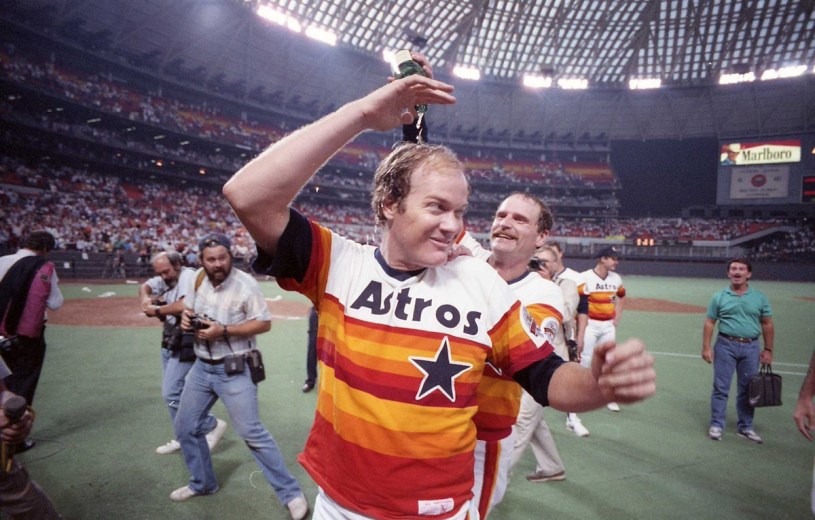
The Mets dropped the Houston Astros in 6 games, needing extra innings to win both Game 5 at home and Game 6 on the road. Both Astros wins came with starter Mike Scott (2-0, 0.50 ERA, 18 IP, 19 Ks, 0.500 WHIP) on the mound—the winner of the NL Cy Young that season. It’s rare for a losing player to win any award, let alone a guy whose team lost in 6 games. Usually, the losing team has to at least reach Game 7.
But with Scott’s dominant victories in Game 1 and Game 4, he was lined up for Game 7—if only the Astros could get there, and they came up short twice in a row in the 12th and 16th innings, respectively. That’s pretty insane, really. The Houston bullpen blew a 3-0 lead in the 9th inning of Game 6, which is crazy when you think about it … on top of what was going on in the ALCS during the same week. Heartbreaking, again.
All things, considered, the Mets escaped this series (and the Fall Classic, too), thanks to some serious luck at the right times. Reliever Jesse Orosco went 3-0 in this matchup, for example, despite his 3.38 ERA in 8 IP. Do any Mets hitters deserve consideration? Only one of them hit .300+ and posted a .900+ OPS: CF Lenny Dykstra. But with just 3 RBI and 1 stolen base, it’s just not good enough to out-do what Scott did here.
[It’s a funny quirk that the Mets won both the NLCS and the World Series—and yet we’ve chosen MVPs from the losing teams in each matchup. That does kind of speak volumes about how “lucky” New York was to win this MLB championship. It’s like the franchise used up two lifetimes’ worth of karma here; the Mets obviously haven’t won another Fall Classic since, despite this roster that was loaded with young talent.]
1986 AL MOTY: John McNamara, Boston (original, confirmed)
The Red Sox outlasted the New York Yankees by 5.5 games to win the AL East, and Boston Manager John McNamara (plus-5 PPP) had the highest positive impact of any manager in the junior circuit during the regular season. That’s usually enough to clinch this award, which he won at the time in the vote. And honestly, there’s no one else here to discuss, as California Manager Gene Mauch (plus-1) was just okay.
1986 NL MOTY: Hal Lanier, Houston (original, confirmed)
Both Mets Manager Davey Johnson and Astros Manager Hal Lanier posted plus-5 PPP marks, with New York winning the NL East by 21.5 games and Houston winning the NL West by 10 games. But the Astros improved 13 victories from the season before, while the Mets “only” improved by 10 wins from 1985’s regular season. Seems to be splitting hairs, but the voters at the time went with Lanier; we will, too.
 Daily McPlay: (mostly) Historical Sports Analysis with TENACITY & VERVE