
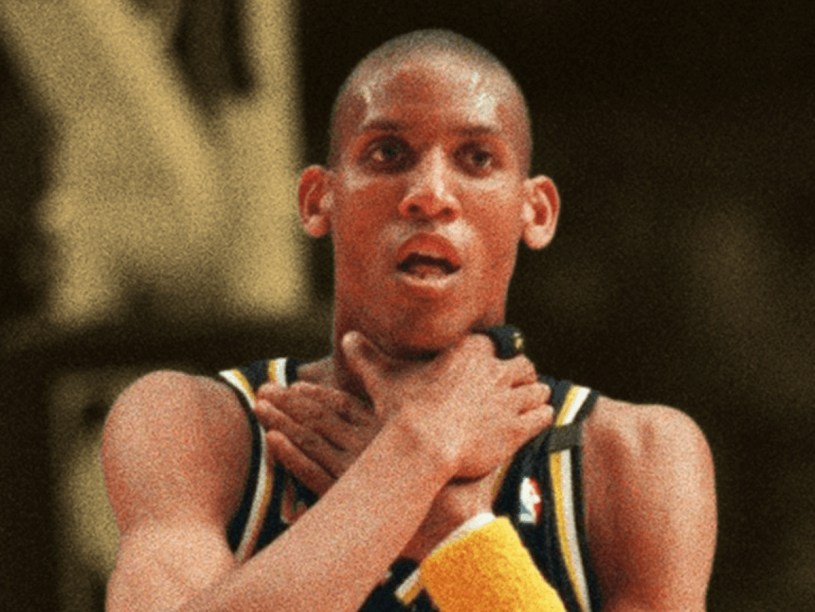
We are back on NBA Tuesday, drifting north from the Gulf of Mexico to the Midwest’s bastion of … something. It’s time for the Indiana Pacers, originally of the ABA, a team that has never won an NBA title—despite winning a trio of them in their original league. That has to be frustrating, although the team certainly has had some good players in its franchise history. And these guys are the 10 best of the bunch!
No. 10: Jermaine O’Neal, C/PF—46.5 WS (2000-2008)
A first-round pick out of high school by Portland, he didn’t do much in his career until he was traded to the Pacers. Then? He made 6 consecutive All-Star teams from 2002-2007. Overall with Indiana, O’Neal posted 18.6 ppg, 9.6 rpg, and 2.4 bpg across 514 regular-season games (and 18.1 ppg, 9.8 rpg, and 2.4 bpg in 50 playoff games). But the Pacers only advanced out of the first playoff round twice during his time in town.
No. 9: Jeff Foster, C—47.5 WS (1999-2012)
In all our travels through this miniseries, this guy stands out as the “best” example of longevity paying off. He played in 764 regular-season games with the Pacers in a relatively meaningless career and averaged just 4.9 ppg and 6.9 rpg. Obviously he never made an All Star team, and Foster was even less of a presence over 53 postseason contests (3.9 ppg, 5.5 rpg). Somehow, that was good enough to make over $50M in his career.
No. 8: Danny Granger, SF—47.6 WS (2005-2014)
A first rounder, he played 544 regular-season games with the Pacers, putting up 17.6 ppg, 5.1 rpg, 2.0 apg, and 1.0 spg over that stretch. Granger was an All Star in 2009, when he averaged a career-high 25.8 ppg for the full season. He only played in 22 playoff games for the organization: his 15.6 ppg, 5.5 rpg, and 2.4 apg averages were underwhelming, as Indiana won a single first-round series in his three playoff trips.
No. 7: Vern Fleming, PG—50.4 WS (1984-1995)
Another first-round pick, he didn’t really have a standout career, never making an All-Star team. A consistent starter for only his first 7 years with the team, Fleming posted 11.7 ppg, 4.9 apg, 3.5 rpg, and 1.1 spg over 816 regular-season games with the Pacers. His postseason impact was even less (7.7 ppg, 3.1 apg) as the team advanced past the first round just once (1994) is his 7 trips to the playoffs. He’s similar to Foster.
No. 6: Billy Knight, C/PF—53.4 WS (1974-1977, 1979-1983)
An All Star for the Pacers in the both the ABA (1976) and the NBA (1977), he had 2 different stints with the team for a total of 585 regular-season games (18.4 ppg, 5.9 rpg, 2.4 apg, 1.1 spg) and 23 postseason contests (24.9 ppg, 8.9 rpg, 2.6 apg). In his rookie year, he helped the Pacers reach the ABA Finals, but he never won another series with Indiana. In between his times with the organization, he played for Buffalo and Boston.
No. 5: Mel Daniels, C—53.4 WS (1968-1974)
His 6 seasons with the team happened in the ABA era, and he was an All Star all 6 seasons: the Pacers won the ABA title in 1970, 1972, and 1973 with Daniels leading the way. He was the voted ABA MVP in 1969 and 1971 while with the franchise, and he was our pick for ABA DOPY in 1969 as well. The stats for the 6-time All Star? 19.4 ppg, 16.0 rpg, and 1.6 bpg in the regular season—and 17.1 ppg, 15.0 rpg, and 1.0 bpg in the playoffs.
No. 4: Rik Smits, C—56.6 WS (1988-2000)
He made just 1 All-Star team in his career (1998), surprisingly, as Smits always seemed to be in the playoffs during his career. His numbers—14.8 ppg, 6.1 rpg, 1.3 bpg—seem pedestrian, however, and his postseason presence (14.8 ppg, 5.2 rpg) underwhelms, too. But he did play in 104 playoff contests for the Pacers, reaching the postseason 10 times in his career (1990-1996, 1998-2000). That’s why his persona looms large.
No. 3: Dale Davis, PF/C—58.4 WS (1991-2000, 2005)
The No. 13 overall pick in the draft, Double D made one All-Star team (2000) in his career, in the final year of his original stint with the Pacers. In 671 regular-season games with the team, he averaged 9.3 ppg, 9.0 rpg, and 1.3 bpg, and in the playoffs (110 games), those numbers were 7.6 ppg, 9.1 rpg, and 1.1 bpg. D Squared also topped the NBA in field-goal percentage one (1998). The Pacers reached the 2000 NBA Finals with him.
No. 2: Roger Brown, SF—63.5 WS (1967-1974, 1975)
The team’s first All Star back in 1968, he spent his entire professional career in the ABA with 3 different teams, but Indiana was his first and last home. Brown also was an All Star from 1970-1972, and he was a team leader on all three ABA title teams. We named him the ABA Finals MVP twice (1970, 1972). Statistics: 18.0 ppg, 6.5 rpg, and 4.o apg in the regular season and 18.7 ppg, 6.4 rpg, and 3.7 apg in the playoffs.
No. 1: Reggie Miller, SG—174.4 WS (1987-2005)
He just blows everyone else on this list away, in terms of length of service—and quality of service. Even so, Miller only made 5 All-Star teams, which doesn’t sound like a lot. He topped the NBA 5 times in free-throw percentage while putitng up 18.2 ppg, 3.0 rpg, 3.0 apg, and 1.1 spg. Miller wasn’t a machine, per se, but in the playoffs, he upped the scoring to 20.6 ppg. In 11 different seasons, he posted double-digit WS marks.
 Daily McPlay: (mostly) Historical Sports Analysis with TENACITY & VERVE