
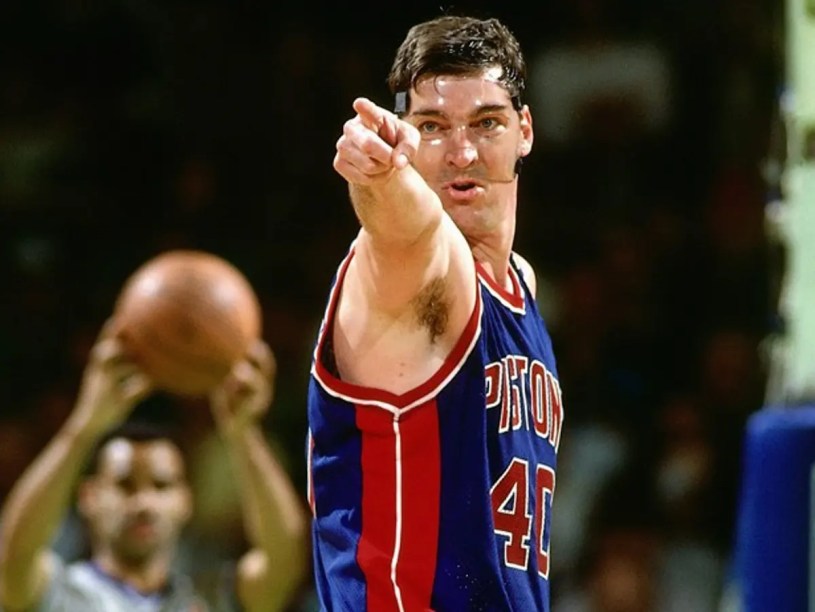
One thing we can say about professional basketball is that no individual team cheats. Yeah, the league itself might have rigged a thing or six, but no team is allowed to cheat, per se. On that note, our current NBA Tuesday miniseries forges on with the Detroit Pistons, ironically enough. What’s even more interesting, though, is the lack of a triple-digit Win Shares leader for this franchise that has been around forever.
No. 10: Larry Foust, C—57.5 WS (1950-1957)
An All Star in his first 6 seasons with the Fort Wayne Pistons, Foust averaged 15.0 ppg and 10.9 rpg over 7 regular seasons with the franchise. He also led the NBA in field-goal percentage once (1955). In 40 playoff games with the team, Foust put up 16.1 ppg and 11.9 rpg, showing an ability to get even more traction when it mattered. However, his hard work never translated into titles, as he lost in the Finals twice (1955, 1956).
No. 9: Tayshaun Prince, SF—57.6 WS (2002-2013, 2015)
This is a quantity-over-quality situation, where Prince toiled away for almost 800 regular-season games with the Pistons, helping them win the 2004 title—despite never being an All Star or anything close to it. His stats (12.6 ppg, 4.7 rpg, 2.6 apg) don’t jump off the page, and the best thing that can be highlighted here is his durability: Prince played in all 82 games for 6 straight seasons (2003-2009), making him an ironman.
No. 8: Grant Hill, SF—60.0 WS (1994-2000)
The No. 3 pick in the draft, Hill was supposed to be the new face of the franchise, but it never really worked out that way. Yes, he was a 5-time All Star for Detroit, but the Pistons never made it out of the postseason first round with him. His numbers—21.6 ppg, 7.9 rpg, 6.3 apg, 1.6 spg—were not the issue; it was more the inability to surround him with talent. All his numbers dropped in the mere 15 playoff games he appeared.
No. 7: Andre Drummond, C—60.4 WS (2012-2020)
Our pick 3 times for DPOY (2016, 2018, 2019), Drummond averaged 14.4 ppg, 13.9 rpg, 1.6 bpg, and 1.4 spg over 591 regular-season games with Detroit. He was a 2-time All Star and led the NBA in rebounding 4 times while with the Pistons (2016, 2018-2020). Sadly, he only reached the postseason twice with the organization, for a total of 8 games: 15.5 ppg, 11.0 rpg, and 1.4 bpg. There was never enough to augment.
No. 6: Ben Wallace, C—65.9 WS (2000-2006, 2009-2012)
In 2 different stints with the franchise, Wallace was a 4-time All Star and a 4-time winner of the DPOY vote (although we revised all of those while awarding him a different season’s nod). Never a big scorer (6.6 ppg with the Pistons), Wallace was a good defender, obviously—11.1 rpg, 2.3 bpg, and 1.4 spg. He was even better in the playoffs, generally, helping Detroit to that 2004 title and an appearance in the 2005 NBA Finals.
No. 5: Chauncey Billups, PG/SG—73.6 WS (2002-2008, 2013-2014)
Mr. Big Shot was the catalyst for the 2004 champions, posting 16.5 ppg, 6.2 apg, and 3.2 rpg over 482 regular-season games with Detroit—starting all but 12 of those games. Ironically, by the time he joined the Pistons, he was on his 5th team in 6 seasons! He made 3 All-Star teams while playing for the team, and in 111 playoff games with Detroit, Billups put up 17.6 ppg, 5.9 apg, 3.5 rpg, and 1.1 spg. He is a Pistons legend.
No. 4: Isiah Thomas, PG—80.7 WS (1981-1994)
Speaking of legends, Thomas was the face of the franchise—for better or for worse—over his entire career, which included 12 All-Star nods, the 1985 assists crown, 3 NBA Finals appearances, and 2 NBA titles (1989, 1990). That’s quite a career, even if he was kind of an asshole. Statistically, Zeke managed 19.2 ppg, 9.3 apg, and 1.9 spg over 979 regular-season games, while playing in 111 postseason games for the Pistons as well.
No. 3: Joe Dumars, SG/PG—86.2 WS (1985-1999)
Dumars and Thomas formed a strong backcourt duo for years, leading to a lot of playoff appearances and successes. Dumars alone made 6 All-Star teams, posting 16.1 ppg and 4.5 apg over 1,018 regular-season games and adding 15.6 ppg and 4.6 apg in 112 playoff contests. Never a dominant superstar, Dumars provided glue and leadership that kept a dysfunctional roster from imploding more often. Amen to that.
No. 2: Bob Lanier, C—91.6 WS (1970-1980)
The anchor of the franchise for a decade, Lanier is in the Hall of Fame for his achievements: a 7-time All Star with the Pistons, including our 1974 nod for DPOY. In 681 stellar regular-season games with Detroit, he averaged 22.7 ppg, 11.8 rpg, 3.3 apg, 2.0 bpg, and 1.2 spg. He was all over the court on both ends, in truth. Sadly, he only reached 22 playoff games with the team, posting 25.6 ppg, 13.8 rpg, 3.5 apg, and 2.5 bpg.
No. 1: Bill Laimbeer, C—98.4 WS (1982-1994)
The Prince of Darkness tops this list, strangely enough—yet appropriately so. The original Bad Boy, he was acquired to protect Thomas, really, and he did his job well: 13.5 ppg, 10.1 rpg, and 3.3 fpg in 937 regular-season games. Throw in his postseasons (12.0 ppg, 9.7 ppg, 3.6 fpg in 113 playoff games), and it’s clear Laimbeer was the clubhouse leader of this team for a decade of success, if not the floor leader in spirit.
 Daily McPlay: (mostly) Historical Sports Analysis with TENACITY & VERVE