
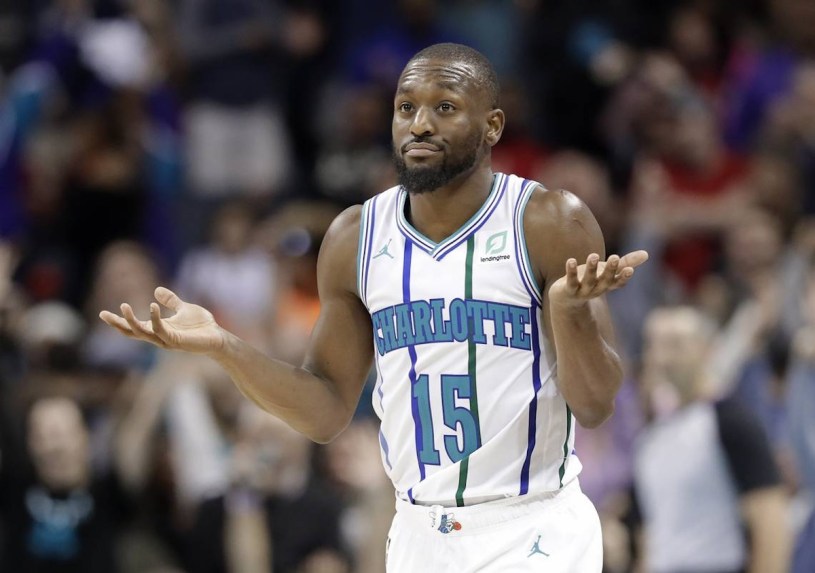
In taking on the best players in the history of the Charlotte Hornets today on NBA Tuesday, we take a peek at the weirdest NBA franchise. Remember, Charlotte is a city that lost its first NBA team only to get another one just a few seasons later, which defies all logic. The metro area is only the No. 21 television market in the nation, but the NBA just seems really determined to make “it” work there, despite rare pro sports success.
No. 10: David Wesley, PG/SG—26.9 WS (1997-2002)
Spending just five seasons with Charlotte, Wesley still enough to make this list. Never an All Star, he averaged 14.5 ppg, 5.3 apg, and 1.5 apg as the Hornets made the postseason 4 straight times with him in the lineup; Wesley started all 32 postseason games Charlotte played in while he was with the club. His numbers in the playoffs? 13.9 ppg, 4.7 apg, and 1.3 spg, so he was a little less effective overall during these key times.
No. 9: Marvin Williams, PF—27.5 WS (2014-2020)
We weren’t even sure who this was, in truth. We don’t even remember him from North Carolina’s cheating national champs from 2005. But we digress: in six seasons with Charlotte, he was a rather forgettable player, despite being on this list, with averages of 9.7 ppg and 5.3 rpg. And that came in 27.1 mpg, too! Needless to say, he was never an All Star, and the Hornets made the postseason once with him on board.
No. 8: Glen Rice, SF—28.4 WS (1995-1998)
It only took 3 seasons with the franchise for Rice to make the Top 10: draw your own conclusions. Rice was the No. 4 overall pick in the 1989 draft, but he never made an All-Star team until he joined the Hornets—and then he was an All Star all three seasons in Charlotte, the only such years of his entire career. While with the franchise, Rice averaged 23.5 ppg, 4.4 rpg, 2.4 apg, and 1.0 spg, leading two teams to the playoffs.
No. 7: Anthony Mason, SF/PF—29.5 WS (1996-1998, 1999-2000)
Like Rice, he played just three seasons in Charlotte, but unlike Rice, his only All-Star year came right after he left the team. He missed a full season to injury, too, in the middle of his Hornets residency. His all-around numbers (13.4 ppg, 10.0 rpg, 4.8 apg) with the team helped redefine the game, somewhat, in truth, and that is Mason’s lasting legacy here. Charlotte made the postseason in all three of his years with them.
No. 6: Cody Zeller, C—31.0 WS (2013-2021)
The first player on this from the Bobcats era, Zeller is still playing this season, albeit for another team. But it took him 8 years with Charlotte to get to this position. Why? Well, his stats—8.7 ppg, 6.0 rpg, 1.4 apg—aren’t that good, really. He’s never been an All Star, of course, and Zeller only saw action in 11 playoff games over those 8 seasons with the team, starting two of them. This is a case of quantity merely adding up some.
No. 5: Dell Curry, SG—31.0 WS (1988-1998)
These days he’s better known as the Sire of Stephen (Curry), but in his own right, Dell was a solid veteran shooter. He spent 10 seasons with the original Hornets, and he sadly didn’t produce much value beyond scoring: 14.0 ppg, 2.9 rpg, 2.0 apg, and 1.1 spg. He was never an All-Star selection (sound familiar for this week?), although he did play in 25 postseason games over 4 playoff years with the team, starting just once.
No. 4: Larry Johnson, PF—41.1 WS (1991-1996)
He missed just two games in the first five seasons of his career, all in Charlotte, and Johnson was twice an All Star (1993, 1995) with the Hornets before leaving for New York. His numbers with the team are really dynamic, actually: 19.6 ppg, 9.2 rpg, and 4.1 apg. It’s hard to explain just how good he was before his body started to break down from all the physicality in his game. Grandmama was the real deal; we never forget.
No. 3: Muggsy Bogues, PG—44.8 WS (1988-1997)
Better known for his stature than anything else, sadly, Bogues was a pretty good player for the Hornets over the course their first decade. Never a big scorer (8.8 ppg), he was a master distributor (8.8 apg) and a master thief (1.7 spg), obviously. He started all 15 postseason games the Hornets played in during his tenure with the team, upping his scoring into double digits (10.3 ppp) in the process. Oh, and then there was this thing.
No. 2: Gerald Wallace, SF/PF—45.9 WS (2004-2011)
An All Star in 2010 for the Bobcats, Wallace played for five different teams in the NBA, but he was in Charlotte the longest. He averaged 16.4 ppg, 7.5 rpg, 2.4 apg, 1.8 spg, and 1.2 bpg to provide all-around value to his team every night out. Wallace topped the NBA in steals one year (2005-2006), and we even named him our pick for Defensive Player of the Year once, too. Not bad for a guy with his scoring ability, you know?
No. 1: Kemba Walker, PG—48.5 WS (2011-2019)
The No. 9 overall pick in the 2011 draft delivered for the Bobcats/Hornets, posting 19.8 ppg, 5.5 apg, 3.8 rpg, and 1.3 spg over 605 regular-season games with the organization. Walker was also an All Star in his final three seasons with Charlotte, and he got the team to the postseason twice, as well, averaging 21.5 ppg in those two playoff appearances, combined. The WS mark is low for a franchise leader; now you know why.
 Daily McPlay: (mostly) Historical Sports Analysis with TENACITY & VERVE