
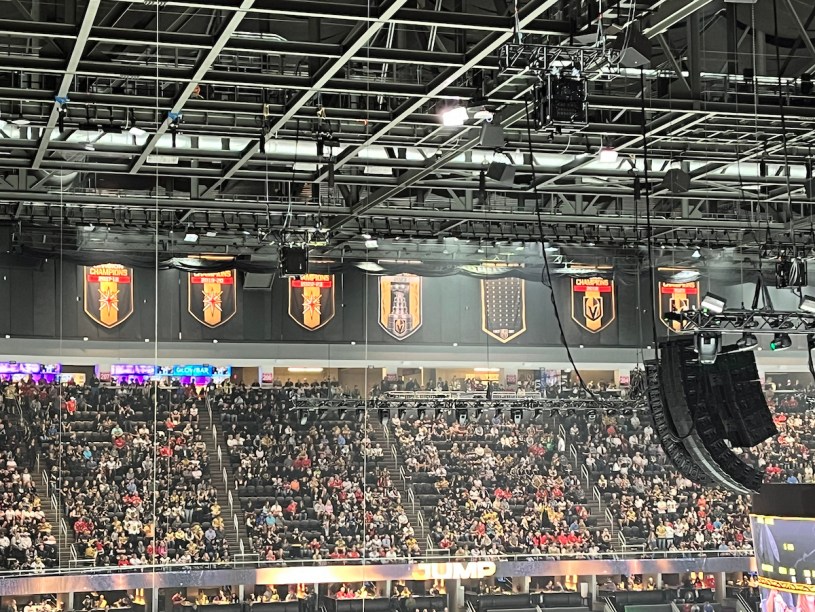
We went to the Chicago Blackhawks at the Vegas Golden Knights matchup on Friday afternoon in Sin City for Nevada Day, and it was a hoot. But what struck us the most sharply was the number of Blackhawks fans in attendance in Las Vegas, despite the Golden Knights—the defending Stanley Cup champions—going for a record eighth-straight win in a defense of an NHL title. Alas, Chicago won in overtime, 4-3, but … what?!
At times it seems like there was no home-ice advantage for the Vegas home team. This is the phenomenon of a metro area that ranks as just the 40th-largest TV market in the country: the visiting team brings its own fans and TV viewership to every home game in Sin City. With so many Blackhawks fans in attendance, the defending Stanley Cup champs may have been missing out on one of the benefits of their success.
During the game, we talked with a retired Chicago policeman and his partner about the experience of coming to Vegas for a game. Of course, Sin City has a lot more to offer than just the hockey game—visiting fans can come for a long week/end, take in their favorite team’s game, and hang out on the Strip for a few days to experience so much more than just sports. That drives the economy in Vegas already: tourism.
Now, it’s adding “sports” tourism to the equation: the less-popular WNBA team is the two-time defending league champions, and the NHL team reigns supreme. The NFL’s Raiders bring their own appeal to the city, too, of course, as you walk down the Strip and see a handful of Silver & Black outlets selling anything and everything to do with the football team. The Raiders made the playoffs their first season in Sin City, too.
The team hasn’t done as well since then, but the same factors remain consistent: there will always be out-of-town fan interest in the Raiders games. After all, what Minnesota Vikings fan doesn’t want to come to Sin City for a weekend of drinking, eating, gambling, and football? The appeal is universal, and it’s a win-win scenario for the Vegas economy—if not the Raiders organization itself, assuming it can manage the market.
Secondary-ticket markets can be lucrative for the original ticket holder, of course, but if the local team can effectively control those sales, too, taking a share of each transaction, that’s just more profiteering for the organization. We don’t pretend to know how that works, but if the Raiders can undercut StubHub’s fees with lower ones themselves, they become the main distributor on the secondary sales market and win big.
That brings us to the Oakland Athletics and their expected move to Vegas: baseball is a different beast than football or hockey in the sense that there are so many games in the season. It may not be as “easy” for the A’s to generate the same ticket-sales market for out-of-town fans, because most baseball matchups are three-game series—and who wants to go to Vegas and spend all their time at the baseball stadium? Only diehards.
And there are plenty of those … but there are also the casual fans who will go to one game no matter who is playing, just to go for the experience. So we think MLB will fine in Vegas, regardless; again, Milwaukee Brewers fans will totally flock to Vegas for a matchup between the Athletics and the Brew Crew—and whether they buy tickets to three games or just one, there will be plenty of them to fill the stands either way.
The Golden Knights have managed to build a champion in a short period of time, of course, and the Raiders have a big enough brand to profit no matter what the team’s success rate—we see this phenomenon in the fact that a lot of Oakland/East Bay fans kept their season tickets for the Vegas relocation and still attend a few games a year by flying on cheap flights for 75 minutes from the California coast to the Nevada desert.
For baseball, it will be interesting to see how the A’s choose to play it, though, without that built-in, local winning tradition of the Knights or the built-in national brand of the Silver & Black. The Athletics will have to win to earn the validation from the locals, for sure, and if the A’s organizational pattern holds, the team can do that early in its Vegas residency. And once they do that, it should mandate a long-term commitment.
To winning, in order to keep pace with the NHL and WNBA champs, of course. Ironic, isn’t it?
 Daily McPlay: (mostly) Historical Sports Analysis with TENACITY & VERVE