
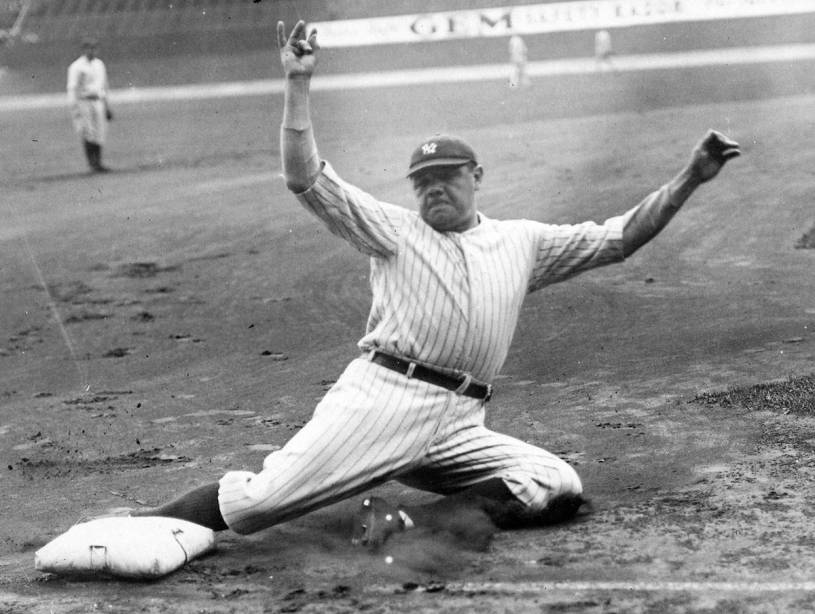
We apologize for the delays, but we’re finally ready to take on the final analysis for the MLB GOAT debate. Last time we narrowed our list to just 18 players for consideration: that wasn’t easy. Now, we have to crunch it all even further, coming up with just one guy among the all-time greats … and this is bound to upset many people, since it’s an imperfect science, even with modern sabermetric measurements and all.
First, from our 10 position players, we just have to eliminate anyone with a negative glove: you can’t be the GOAT if you can’t play the field, no matter what you bring to the table offensively. So, here is a list of the 10 position players, in order of glove work, and we understand this is imperfect due to data available for the distant past, but we have to be consistent with the metrics we have been using all along this process:
- Honus Wagner: 21.3 dWAR
- Johnny Bench: 19.7 dWAR
- Mike Schmidt: 18.4 dWAR
- Willie Mays: 18.2 dWAR
- Rogers Hornsby: 13.9 dWAR
- Jackie Robinson: 10.3 dWAR
- Babe Ruth: -2.3 dWAR
- Rickey Henderson: -2.3 dWAR
- Lou Gehrig: -9.0 dWAR
- Ted Williams: -13.3 dWAR
So, despite the Iron Horse’s legacy for consistency and the Splendid Splinter’s reputation for hitting, both are going to be eliminated here. Williams’ indifference to fielding was well known, and Gehrig aporadically played other positions, but the New York Yankees probably hid him at first base for a reason. As for Ruth and Henderson, their long careers and other accomplishments will give them a free pass here (for now).
Thus, we are down to 8 position players. We will come back to them; what about the 5 starting pitchers? The worst thing a pitcher can do is walk guys, put runners on base too often, and give up home runs. So, how does our all-time rotation stack up in this way? We’re just going to look at BB/9, WHIP, and HR/9 here to sort them out, in the following order to see which ones fall slightly off the pace set by the best of them:
- Walter Johnson: 2.1 BB/9, 1.061 WHIO, 0.1 HR/9
- Pete Alexander: 1.6 BB/9, 1.121 WHIP, 0.3 HR/9
- Clayton Kershaw: 2.2 BB/9, 1.004 WHIP, 0.7 HR/9
- Lefty Grove: 2.7 BB/9, 1.278 WHIP, 0.4 HR/9
- Randy Johnson: 3.3 BB/9, 1.171 WHIP, 0.9 HR/9
Okay—we know the old timers didn’t give up dingers very often due to ballpark size and baseball elements themselves. Still, when we rank these guys with the combined numbers, this is what we get: Grove’s WHIP is just way too high, and his BB rate doesn’t help there, either. Johnson’s BB rate was better as he got older, but he was still the “wildest” of the bunch, while also giving up the most HRs, too. We have to cut both.
Now, what about the three relievers that made our cut to this point? Two of our finalists did some time as starters, so we’re just going to use their relief splits for the same kind of exercise as above. And they’re all “modern” guys, of course, since relief pitching as a speciality didn’t start evolving really until the 1970s. It is what it is, and this is the way they end up ranked using the same metrics as the ones above for starters:
- Mariano Rivera: 1.9 BB/9, 0.973 WHIP, 0.5 HR/9
- Dennis Eckersley: 1.4 BB/9, 0.998 WHIP, 0.9 HR/9
- Billy Wagner: 3.0 BB/9, 0.998 WHIP, 0.8 HR/9
Wagner’s walks hurt him, although not in the WHIP, where all three guys are pretty even. Eck had the best control, but he surrendered the most HRs—which might have something to do with the fact he was older when he was a reliever (i.e., lower velocities). Either way, Rivera has a slight edge on Eckersley, and Wagner is below them both. This reduces us to just two relievers, though, and that’s a start. Now, the tough part …
We have 8 position players, 3 starting pitchers, and 2 relief pitchers now. We have cut it down from 18 to 13 finalists, and in reality? We can’t really consider a relief pitcher as the “best ever” anything except relief pitching. So, with all due respect to Rivera and Eckersley, they’re getting the boot here. Specialty guys matter in the sport, but they’re not on the field of play enough to warrant GOAT consideration. ‘Tis wha’ ’tis.
Who is the best SP? Choosing between the Big Train and Old Pete is pointless, and they both benefitted from the era they played in. Considering that, we’re actually going to go with Kershaw, because is numbers are incredible for his entire career being in the twenty-first century of PEDs, sign stealing, and small ballparks. Yes, we know he’s had his postseason struggles, but that is irrelevant here because of sample size.
Now, since all our remaining position players have passed the glove test, let’s move to OPS+ as it is the only true way to measure players from different positions when it comes to their offensive prowess. Bench (126) and Henderson (127) have the lowest OPS+ marks, so their time is up. Even though Henderson is the all-time MLB leader in runs and steals, he already burned up his free pass with the slightly negative glove.
We’re surprised Bench’s OPS+ isn’t higher, considering the dearth of quality-hitting backstops. But, oh well! In present company, too, we also want to have a threshold for OPS+, in general: four of our position players are over 150, so that’s going to be our cut line. We thus say goodbye to Robinson (133) and Schmidt (148). Honestly, Jackie just didn’t play enough MLB seasons, and Schmidt is pretty close to our cut off. Hmmm.
As the most “recent” position player, we’d like to keep the Philadelphia great in the discussion—yet his .267 batting average pails in comparison, too, to everyone else still alive. Ruth, Hornsby, Wagner, and Mays are all .300-plus hitters, so it’s fair to excise Schmitty at this point. So, it comes down to Ruth, Wagner, Hornsby, and Mays. The Babe’s offensive numbers dwarf everyone else’s really, and then there’s this fact.
His pitching.
This was always going to be hard to escape: Ruth won 94 games, tossed 17 shutouts, and even recorded 4 saves among his 1,221-plus innings. His 2.28 ERA and 1.159 WHIP are just frosting on this cake, when you consider he also posted a 206 OPS+, the only player in our analysis over 200 in that metric. Hornsby’s 175 OPS+ effort is amazing in itself, but it still can’t hold a candle to Ruth’s production levels. Simple as that.
Maybe it was always going to come down to this, but we had to try. Ruth is probably the best hitter in the history of the game, and even though his glove was slightly below average, he makes up for it with his pitching skills. A quick comparison to modern-day, two-way star Shohei Ohtani? The Los Angeles Angels dynamo has a 148 OPS+ and an 3.01 ERA/1.082 WHIP combination. That’s incredible enough, and yet …
Ruth’s numbers dwarf it. There really shouldn’t be much of a debate here. It’s all about the Babe—and it always will be, because we just can’t fathom anyone topping his statistical dominance, overall. Case closed.
 Daily McPlay: (mostly) Historical Sports Analysis with TENACITY & VERVE