
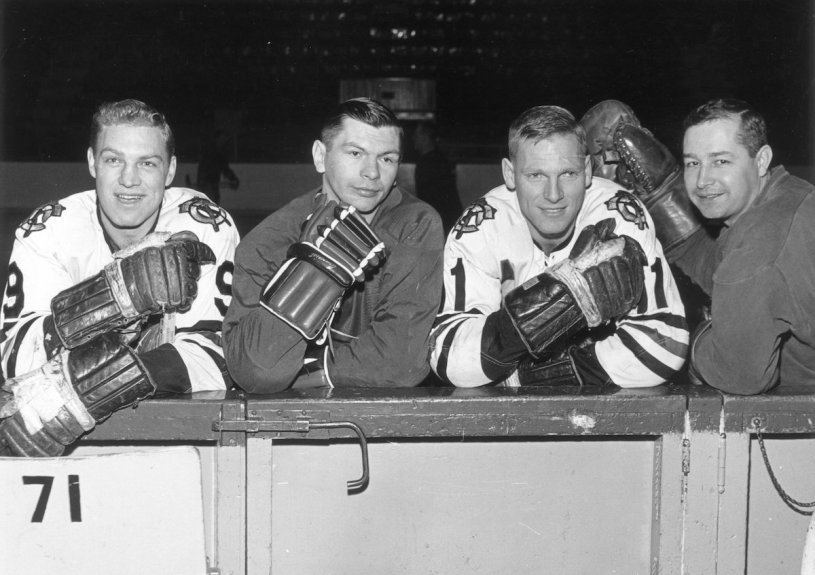
Our special added segment to the second NHL Saturday miniseries exploring the Original Six era (1943-1967) on The Daily McPlay comes to an end today. This was the 25-year stretch where the National Hockey League had just six teams: the Boston Bruins, the Chicago Black Hawks, Detroit Red Wings, the Montréal Canadiens, and the New York Rangers. We finish this journey in the Windy City, with the Black Hawks.
The team’s first season started in 1926, and in the 96 seasons since then, the franchise has won 6 Stanley Cup titles, 17 division titles, and 63 postseason berths. During this specific era, however, Chicago won the Cup just once—in 1961, a team that did not make the list below. In this 25-year era, the Black Hawks, the Bruins, and the Rangers combined to win just 1 Stanley Cup title, as the other teams dominated the times.
No. 5: 1961-62 Chicago Black Hawks
The team didn’t change its name to the “Blackhawks” until 1986, by the way, and this team was the defending Cup champion. This group scuffled its way to a 31-26-13 record for 75 points and third place. Appropriate since Chicago pulled the 3-3-3 combo for offense, defense, and SRS ranking. In the semifinals, though, the champs came alive, beating the No. 1 Canadiens in six games. Alas, Toronto beat Chicago in the Cup Finals.
The roster was topped by serious talent: left wing Bobby Hull (50G, 34A, 35 PIMs), right wing Stan Mikita (25G, 52A, 97 PIMs), and center Bill Hay (11G, 52A, 34 PIMs)—all Hall of Fame skaters. In the crease, goaltender Glenn Hall (.914 GAA, 9 SOs) was dealing, starting every game. Montréal went up 2-0 before Chicago won four straight to advance. But the Leafs also got ahead 2-0 before winning the series in six.
No. 4: 1964-65 Chicago Black Hawks
A 34-28-8 record produced 76 points and another third place finish, built upon the No. 1 offense, the No. 3 defense, and the No. 2 overall SRS ranking. The Black Hawks played the maximum 14 postseason games, beating Detroit in 7 games before losing to Montréal in 7 games. Against the Red Wings, the home team won every game—until the last one. Against the Habs, the home team won every game including Game 7.
Mikita (28G, 59A, 154 PIMs) and Hull (39G, 32A) were dominant again, joined by defenseman Pierre Pilote (14G, 45A, 162 PIMs) and future legend Phil Esposito (23G, 32A, 44 PIMs), also at center. Hall (19-16-5, .923, 4 SOs) split time with Denis DeJordy (15-12-3, .917, 3 SOs) in the net. Hall won Game 7 in Detroit, but against Montréal, the Habs got to Hall aplenty in a 4-0 victory that secured a relatively surprising Cup win.
No. 3: 1963-64 Chicago Black Hawks
Notice how all these teams are bunched up in the same stretch of the ’60s? We do. Thanks to 84 points and a 36-22-12 record, these Black Hawks finished second—with the No. 1 offense, the No. 2 defense, and the No. 1 overall SRS ranking. But Chicago was upset in the semifinals by the Detroit Red Wings: the Black Hawks lost twice on home ice, including Game 7. Overall, Detroit outscored Chicago, 24-18, in the series, too. Ouch.
Mikita (39G, 50A, 146 PIMs), Hull (43G, 44A, 48 PIMs), Pilote (46A, 84 PIMs), and Hay (23G, 33A) were joined by RW Kenny Wharram (39G, 32A) on the high-scoring offense. Hall (34-19-11, .930, 7 SOs) anchored the netminding corps. So what happened in the semifinals? Detroit stole Game 2 on the road and blanked Chicago in Game 3 back home. The Black Hawks just couldn’t find a rhythm to get back on top.
No. 2: 1965-66 Chicago Black Hawks
Finishing second with a 37-25-8 record for 82 points, this Chicago team featured the No. 1 offense and the No. 2 defense—adding up to the No. 2 overall SRS ranking. But once again, the fourth-place Red Wings rose up in the semifinals to flatten the Black Hawks, this time in just six games. Chicago won Games 1 and 3 by identical 2-1 scores, but otherwise, Detroit outscored the Black Hawks, 20-6, in its four series victories.
Hull (54G, 43A, 66 PIMs) and the three Cs—Mikita (30G, 48A, 58 PIMs), Esposito (27G, 26A, 49 PIMs), Hay (20G, 31A)—were the top dogs on the scoring sheet this time out. At age 34, Hall (34-22-8, .916, 4 SOs) was still sharp in the crease, too. But it all fell apart in the playoffs, really: his GAA dropped to .878 for the series, and the skaters could put together just 10 goals in the six games. It was a hot mess of a loss for Chicago.
No. 1: 1966-67 Chicago Black Hawks
For the third time in this short series of profiles, an O6 team’s best squad was the last one of the era: these Black Hawks took first place with a 41-17-12 record for 94 points. Chicago also pulled off the 1-1-1 trifecta, so it clearly was the Cup favorite. However … here we go again … the Maple Leafs rose up and knocked off the Black Hawks in six games. Chicago lost twice in three games on its home ice, and that was the series, sadly.
Six skaters posted at least 50 points: Mikita (35G, 62A), Hull (52G, 28A), Wharram (31G, 34A), Esposito (21G, 40A), D Doug Mohns (25G, 35A), and Pilote (46A, 90 PIMs). DeJordy (22-12-7, 4 SOs) finally displaced Hall (19-5-5, 2 SOs) as the top goalie, however. They ended up splitting time in the postseason, although it didn’t matter. DeJordy lost Game 2 on home ice, and the Black Hawks never could regain enough momentum.
 Daily McPlay: (mostly) Historical Sports Analysis with TENACITY & VERVE