
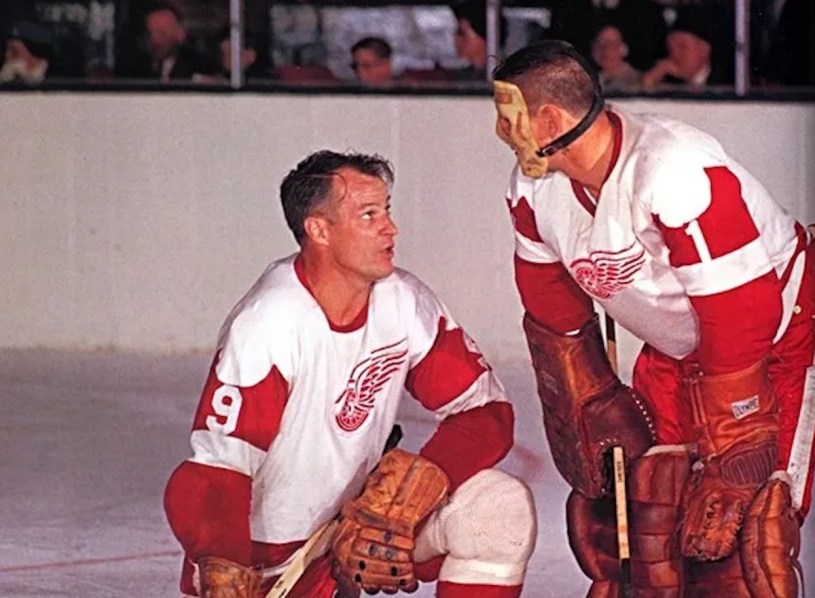
This special added segment to the second NHL Saturday miniseries explores the Original Six era (1943-1967) on The Daily McPlay. This was that 25-year stretch where the National Hockey League had just six teams: the Boston Bruins, the Chicago Black Hawks, Detroit Red Wings, the Montréal Canadiens, and the New York Rangers. It’s time to explore that era, somewhat properly, and today, we take on Hockeytown in all its glory.
The team’s first season started in 1926, and in the 96 seasons since then, the Red Wings have won 11 Stanley Cup titles, 29 division titles, and 64 postseason berths. During this specific era, too, Detroit won 5 Cup championships—including the first year (1943) of the Original Six period. However, the Wings later went from 1956-1996 without hoisting Lord Stanley’s trophy, which was quite the dry spell. This list verifies that.
No. 5: 1954-55 Detroit Red Wings
A 42-17-11 record produced 95 points and resulted in a first-place finish, thanks to the No. 2 offense, the No. 1 defense, and the No. 2 overall SRS ranking. Detroit had no issues dispatching the Maple Leafs in four straight to open the playoffs, but the Finals against the Canadiens went the full seven games. Overall, the Wings outscored Montréal, 27-20, in the series, and they used home-ice advantage to win the finale, 3-1.
Center Dutch Reibel (25G, 41A) and right wing Gordie Howe (29G, 33A, 68 PIMs)—you may have heard of him—were the top scorers on this team. Meanwhile, defenseman Red Kelly (15G, 30A) and goaltender Terry Sawchuk (40-17-11, 1.96 GAA, 12 shutouts) anchored the impressive defense. These are some legendary guys. Future star G Glenn Hall (2-0-0, 1.00) also played on this team; C Alex Delvecchio was Game 7’s star.
No. 4: 1944-45 Detroit Red Wings
This team competed during the final year of World War II with whatever guys weren’t fighting the war; with a 31-14-5 record for 67 points, Detroit finished second behind a 2-2-2 combo of statistical data. After beating Boston in seven games to reach the Finals, though, the Red Wings fell in seven games to Toronto. This was crushing as Detroit had home ice in Game 7, but the Leafs came out ahead by a 2-1 score to clinch.
RW Joe Carveth (26G, 28A), C Syd Howe (17G, 36A), and D Flash Hollett (20G, 21A, 39 PIMs) were the skating stars at the top of the points list for Detroit, as G Harry Lumley (24-10-3, 1 SO) held down the crease. He was just 18 years old. Four games against the Bruins were decided by 1 goal, with the Wings winning three of them. In the Finals, however, it was the exact opposite—in favor of Toronto, of course.
No. 3: 1951-52 Detroit Red Wings
We have another Cup winner here: based on a 44-14-12 record for 100 points, this Detroit squad finished first in the standings. The Wings also owned the 1-1-1 magic combo here in a strong showing of league dominance. Another sign of ultimate awesome? Detroit swept both rounds of the playoffs: the Wings outscored the Leafs, 13-3, in the semifinals, and they outdid the Canadiens in the Finals by an 11-2 margin.
Gordie Howe (47G, 39A, 78 PIMs) dominated the stat sheet, although left wing Ted Lindsay (30G, 39A, 123 PIMs), C Sid Abel (17G, 36A, 32 PIMs), and Kelly (16G, 31A) also were pretty good themselves. Sawchuk started all 70 games (1.90, 12 SOs). Seriously, it’s hard to fathom how this team finishes just No. 3 on this list, although we know how fussy sabermetrics sometimes can be. These Wings did play the worst SOS, after all.
No. 2: 1952-53 Detroit Red Wings
Detroit won Cups in 1950, 1952, 1954, and 1955—but this was a season that got away, despite a 36-16-18 record for 90 points and another first-place finish. The Red Wings rang up another 1-1-1 statistical triumph, but they somehow let the Bruins get the best of them in the semifinals. After winning Game 1 by a 7-0 score on home ice, Detroit lost the next three games by a 13-6 score and never recovered, losing it all in Game 6.
It was the same cast of characters here: Howe (49G, 46A, 57 PIMs), Lindsay (32G, 39A, 111 PIMs), Delvecchio (16G, 43A), Kelly (19G, 27A), Sawchuk (32-15-16, 1.89, 9 SOs), and Hall (4-1-1, 1.67, 1 SO). Did the Wings get overconfident after that Game 1 blowout? Game 3 in Boston was the tipping point, really, as the Bruins escaped with a 2-1 overtime victory to grab control of the series. If the Wings could have won it? Oh well.
No. 1: 1950-51 Detroit Red Wings
Again, Detroit did not win the Cup with this team, which rates out the best in Original Six organizational history: 44-13-13, 101 points, first place, No. 1 offense, No. 2 defense, No. 1 SRS ranking. The Wings lost a strange, six-game series to Montréal: the Habs won both Games 1 and 2 on the road in multiple OTs each before Detroit won Games 3 and 4 on the road in regulation. However, the Wings dropped the next two.
Here we go again with the roll call of legends: Howe (43G, 43A, 74 PIMs), Abel (23G, 38A), Lindsay (24G, 35A, 110 PIMs), Kelly (17G, 37A), and Sawchuk (70 starts, 1.97, 11 SOs). You have to wonder how these teams ever lost … alas, it took the Canadiens 4 OTs to win Game 1 and 3 OTs to win Game 2. Detroit shot its collective wad winning the next two on the road, and the Wings just ran out of gas in the end, strangely.
 Daily McPlay: (mostly) Historical Sports Analysis with TENACITY & VERVE