
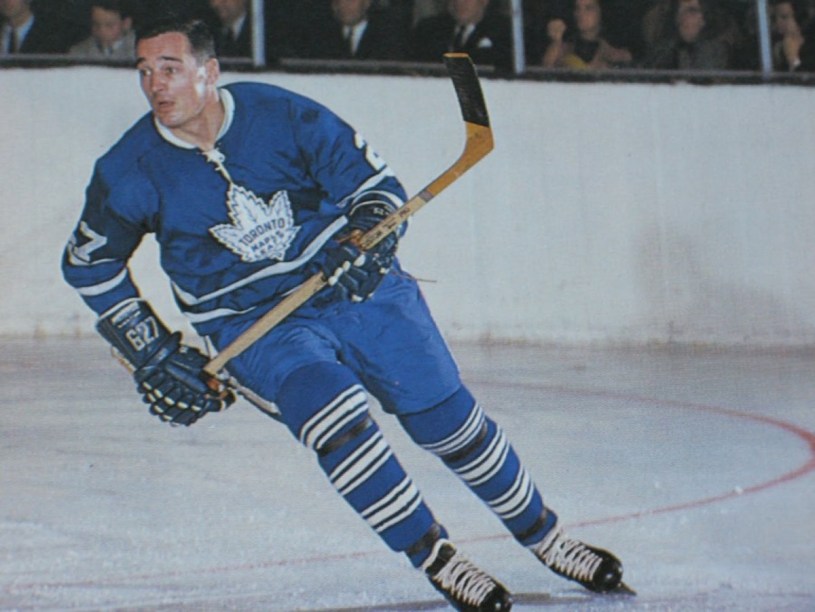
We’ve decided to add a special segment to this second NHL Saturday miniseries, since we really have not explored the Original Six era (1943-1967) on The Daily McPlay. This was that 25-year stretch where the National Hockey League had just six teams: the Boston Bruins, the Chicago Black Hawks, Detroit Red Wings, the Montréal Canadiens, and the New York Rangers. It’s time to explore that era, so here go.
The Toronto Maple Leafs were founded in 1917, so they predate the “established” NHL, really. In 105 seasons, overall, the Leafs have 72 postseason appearances and 13 Stanley Cup championships—although none of them have come since the Expansion Era began in 1968. That’s quite the anomaly, for sure. Someday, when Toronto does win the Cup again—and we will be rooting for that to happen—there will be a big party. BIG.
No. 5: 1961-62 Toronto Maple Leafs
With a 37-22-11 record for 85 points, these Leafs finished second in the league behind the Canadiens. The team had the No. 2 offense, the No. 2 defense, and the No. 2 overall ranking in the SRS. In the odd playoff format of the time, Toronto played No. 4 New York in the semifinals, beating the Rangers in six games. As Montréal had lost to No. 3 Chicago in the postseason, the Leafs got a break—and won the Cup in six games.
The top scorers were all centers: Frank Mahovlich (33G, 38A, 87 PIMs), Dave Keon (26G, 35A), and George Armstrong (21G, 32A)—all in the Hall of Fame now, along with top goaltender Johnny Bower (31-18-10, 2 shutouts, 2.56 GAA). Against the Rangers, winning Game 5 in double overtime was the big victory, and in the Finals, a 2-1 triumph on the road in Game 6 clinched Lord Stanley’s silver chalice for Maple Leafs.
No. 4: 1942-43 Toronto Maple Leafs
This team finished third in the league, despite the No. 2 overall SRS ranking. The 22-19-9 record for 53 points doesn’t really do the sabermetrics justice, which included the No. 1 offense and the No. 2 defense. Being the No. 3 seed in the postseason, though, was a curse, since that meant playing the top team from the regular season. The Leafs lost to eventual champion Detroit in six games, as a result, losing an OT Game 6.
Right wing Lorne Carr (27G, 33A) and C Billy Taylor (18G, 42A) tied for the team lead in scoring, and neither of them are in the Hall of Fame. But G Turk Broda (1 SO) is in the Hall, and he started all 50 games for Toronto, playing every minute in every game. In the playoff series against the Red Wings, the Leafs were outscored by Detroit, 20-17, losing both Games 5 and 6 by a combined three goals. That was the difference.
No. 3: 1943-44 Toronto Maple Leafs
Another No. 2 SRS finish didn’t translate to a beneficial spot in the standings: Toronto posted a 23-23-4 record to come in third place, despite the No. 3 offense and the No. 2 offense. That meant a semifinal matchup with the dominant Canadiens, who won 38 times in 50 games during the regular season. The Leafs won Game 1 on the road, but then Montréal obliterated them, winning four straight by big margins.
Carr (36G, 38A) had a huge season, but so did C Gus Bodnar (22G, 40A) and defenseman Babe Pratt (17G, 41A, 48 PIMs). Meanwhile, Gs Paul Bibeault and Benny Grant combined for 5 shutouts, despite the team’s middling record. But that high-water mark of the 3-1 victory in the first playoff game was long forgotten after the Canadiens outscored Toronto, 22-3, in the next four. That is just painful to look at, even now.
No. 2: 1960-61 Toronto Maple Leafs
Often, titles are won a year after a crushing postseason defeat, and this season set up the ’62 Cup championship. The Leafs went 39-19-12 for 90 points second place in the league, thanks to the No. 2 offense, the No. 1 defense, and the No. 2 overall SRS ranking. This seemed perfect to miss out on first place by just 2 points in the standings, but the No. 4 Red Wings rose up and smacked down Toronto in a five-game upset.
Mahovlich (48G, 36A, 131 PIMs) had a dazzling season, supported quite ably by C Red Kelly (20G, 50A). At age 36, Bower turned in another great season: 33-15-10 with a .922 save percentage and 2 shutouts. So what went wrong in the playoffs against Detroit? Well … Toronto won Game 1 in double overtime, and that seemed to sap its collective strength. The Wings won the next four games by a combined 13-5 score. Ouch.
No. 1: 1950-51 Toronto Maple Leafs
The best Original Six team from Toronto ended up with a 41-16-13 record for 95 points in second place. Losing out to the 44-win Red Wings wasn’t a bad thing. The Leafs had the No. 2 offense, the No. 1 defense, and the No. 2 overall SRS ranking. They silenced the Boston Bruins in the first round, limiting them to just five goals in six games. In the Finals against Montréal, it was Toronto winning it all in five crazy games.
C Max Bentley (21G, 41A, 34 PIMs) and C Ted Kennedy (18G, 43A, 32 PIMs) ran the offensive show, while Broda (15-10-6, 2.23 GAA, 5 SOs) combined with Al Rollins (26-6-7, 1.77 GAA, 5 SOs) in net to be quite the dominant duo. Broda dealt two shutouts among his four wins against Boston, and in the Finals, it was all goaltending as every game went into overtime: Rollins dominated this time, going 3-0 with a 1.61 GAA.
 Daily McPlay: (mostly) Historical Sports Analysis with TENACITY & VERVE