
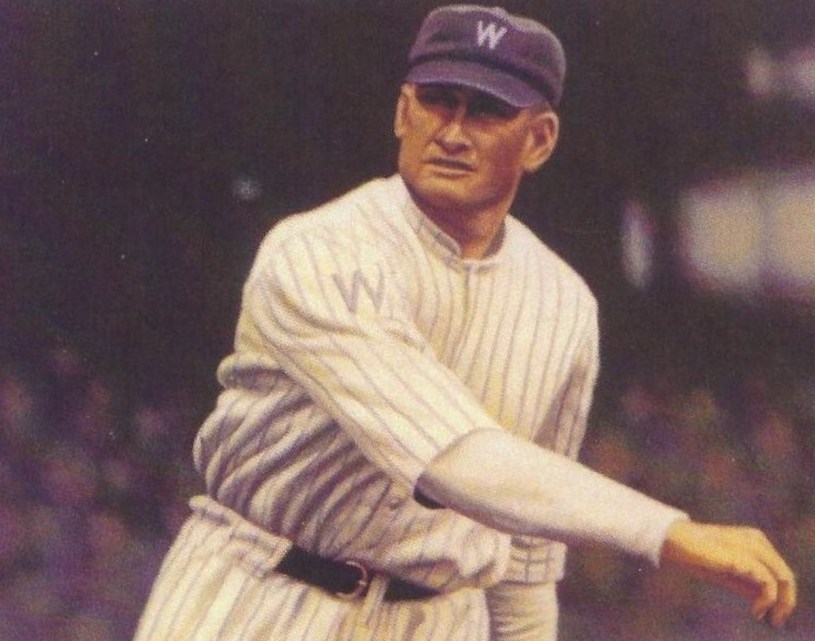
We’re looking at the start of the MLB GOAT debate, and that means we will put out an era-best lineup for the Dead Ball Era today, spanning from the start of the World Series to the end of the World War I, really. That’s the years from 1903-1919, and what we have below is our choices for the best players in a traditional lineup, pitching staff, and bench for these seasons, overall. Not much else to say, so let’s get it going now!
Catcher: There are really only two guys who rate out worthy for this era/position combination—Roger Bresnahan (20th-highest WAR total at the position, 42.1 WAR) and Johnny Kling (43rd, 29.1). Two other players played enough of their careers in this era to warrant consideration as well, but we will consider them next Sunday, though. But neither of these two guys will get advanced to the final analysis.
First Base: This is a short discussion for this era/position combination. It begins and ends with Frank Chance, the great Cubs player-manager. But he rates only 39th all-time among first sackers in WAR (46.0), despite our choosing him as our NL MVP in 1904. His managerial career—which includes us picking him three times as NL MOTY—doesn’t matter here, even if he was pulling double duty for many seasons.
Second Base: Surprisingly, this is a stacked position in this era. Rogers Hornsby (1st, 127.1), Eddie Collins (2nd, 124.2), and Nap Lajoie (3rd, 106.9) are all players who could be advanced to our finals of the MLB GOAT discussion. Should we even bother trying to reduce this grouping to one or two guys?! They all finished with positive dWAR marks, although we will move Hornsby to the next era, as his career spanned 1915-1937. Collins played from 1906-1930, so he belongs here. He also won six World Series and three AL MVPs from us, while Lajoie didn’t win much else other than a single AL MVP from us—and a Triple Crown. We can slide Lajoie to the utility category below here, for sure.
Third Base: Only three candidates here, and two of them are obvious—Frank Baker (14th, 62.8), better known as “Home Run” Baker to posterity; Heinie Groh (29th, 48.4), who played from 1912-1927; and Tommy Leach (31st, 47.1). Baker really is the top dog here, and he also won our 1913 WS MVP nod. Groh is an era straddler, and Leach is an inferior player. Still, we don’t see Baker really advancing beyond this.
Shortstop: The great Honus Wagner (1st, 131.0) dominates here, so he will get advanced to the finals eventually, of course. Is there anyone else we can consider for the utility section below? Not really; Wagner won six NL MVP trophies from us, which is pretty stellar. He also helped win the 1909 World Series.
Left Field: This is a fun space to analyze, as we could consider as many as five guys—with none of them being advanced to the final discussion. The top guy from this era is Fred Clarke (10th, 68.0), followed by the more-famous Zack Wheat (14th, 60.4). No one else is worth mentioning, under the circumstances.
Centerfield: Legends Ty Cobb (2nd, 151.4) and Tris Speaker (3rd, 134.9) rule this roost, for sure. Cobb surprisingly only won three AL MVPs from us, as Speaker won the same award four times in our estimation. Speaker also won three World Series, while Cobb famously never did. One thing that stands out to us as well is Cobb’s negative glove (minus-10.4 dWAR), so Speaker gets this space—with Cobb advancing to the utility discussion below. That’s something many of you maybe did not see coming! More on him later.
Right Field: This is another situation where we only consider two guys—Sam Crawford (8th, 75.3) and Joe Jackson (17th, 62.2). Both were negative defenders, though, so that’s not a great look. Jackson, of course, had his career cut short by circumstance and scandal, so Crawford gets the positional nod without final advancement, however. Shoeless Joe could have been even greater than he was, if fate had not intervened.
Pitchers: This is easily the toughest category we anticipated for this era, and this is what we get in terms of the top three guys—Walter Johnson (1st, 165.1), Christy Mathewson (9th, 106.5), and Eddie Plank (14th, 90.8). While Mathewson and Plank were great, no one can stop the Big Train from advancing to our final discussion. While he won just one Series title (1924), Johnson managed to snag five Cy Young nods from us. Mathewson won eight NL Cy trophies from us, but his career was cut short by World War I. We will advance him to the finals, nonetheless. Plank makes this short list, without advancement, however. Tough breaks.
Utility Players: In this space, we have Lajoie and Cobb, both incredibly amazing players in one way or another. Perfectly so, Lajoie played every infield position in his career, and Cobb played every outfield position in his career, too. That makes them both perfect UTL guys for this analysis—and for advancement.
So, who would we advance out of this bunch to our final analysis, to take place later this summer, from August 20 to September 3? Bresnahan is a Top 20 player at his position, but he will not make it to the final round. Chance is in the Hall of Fame, but he’s not a GOAT finalist. Collins will get advanced, however, but Baker will not. Wagner will, too, obviously. Speaker is the only one of the “starting” outfielders to move on.
Both Lajoie and Cobb deserve it, too, despite some reservations we can sort out later. For the pitchers, we’re pushing both Johnson and Mathewson—but no one else, really. We have to stay cream-of-the-crop sharp, truly. That’s the hard part, drawing that arbitrary line in the dirt, keeping some guys in and forcing some guys out. This is not a perfect process, and the initial screening of so many different eras is really tough.
To recap, then, our Dead Ball Era GOAT lineup is as follows: C Bresnahan, 1B Chance, 2B Collins, SS Wagner, 3B Baker, LF Clarke, CF Speaker, RF Crawford, SP Johnson, SP Mathewson, SP Plank, UTL Lajoie, and UTL Cobb. Advancing to the finals discussion later are the seven players noted above: five position players and two pitchers. That’s a good size to aim for in the individual era analyses to follow. Stay tuned!
 Daily McPlay: (mostly) Historical Sports Analysis with TENACITY & VERVE